
For UK builders, skip hire is the standard way to handle bulk waste. It's faster and safer than repeated trips to the tip.
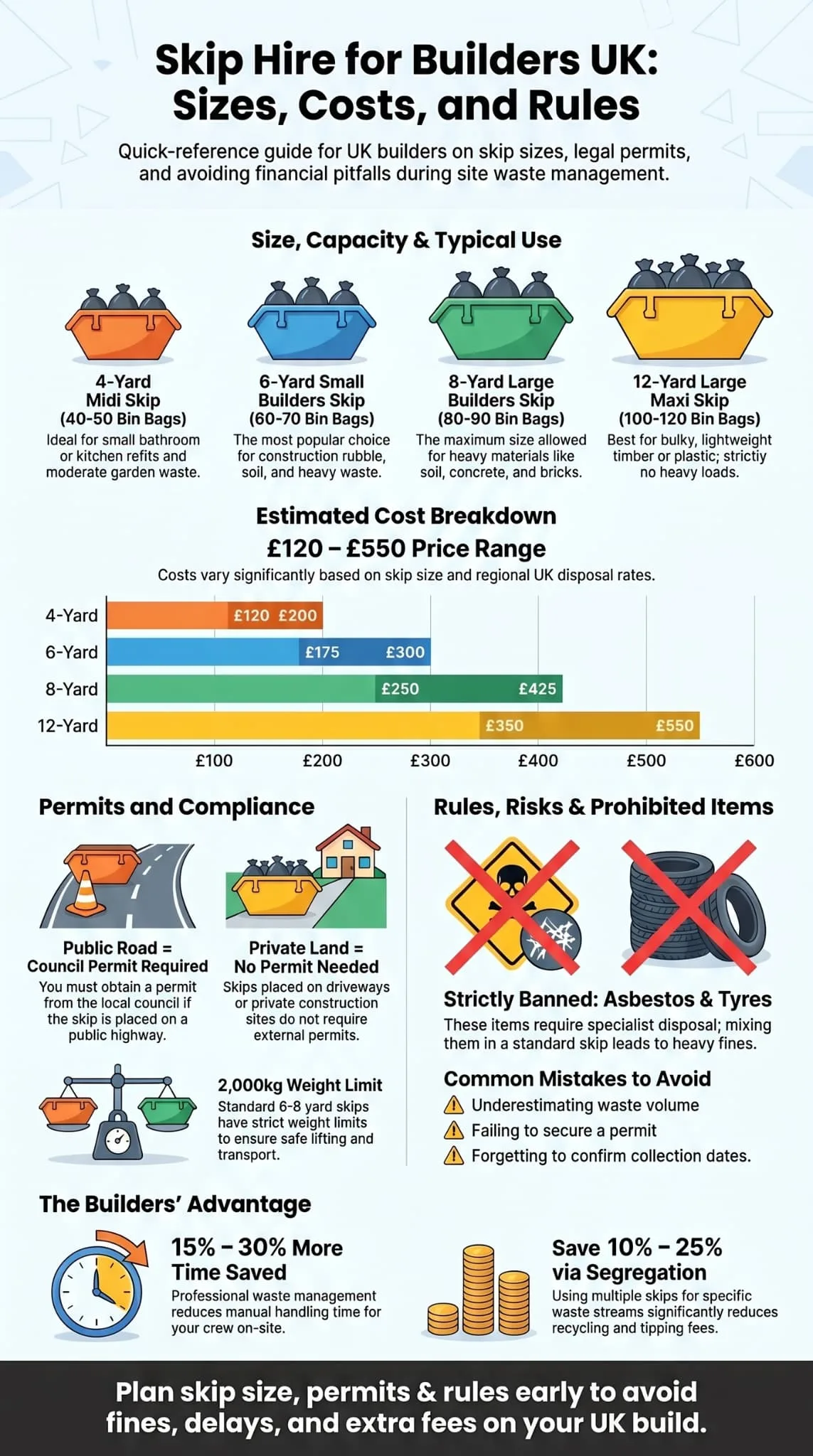
The most common choice is a 6-yard or 8-yard builders skip, which balances good capacity with site access. The average cost for a week's hire typically falls between £200 and £340, excluding VAT, but this depends heavily on your location and waste type.
To avoid unexpected fees and delays, you need to understand weight limits, permit rules, and prohibited items.
Keep reading to learn how to plan your skip hire effectively and keep your project running smoothly.
Builder’s Skip Hire Essentials: The Rules That Save You Trouble
These key points highlight the most important things builders should know to avoid delays, fines, and unnecessary skip hire costs.
Pick the right skip size: Choosing correctly prevents expensive overflows or wasted capacity, with 6-yard and 8-yard skips being the most practical for residential jobs.
Check permit requirements early: Placing a skip on a public road without council approval can cause fines and project delays.
Know the limits and restrictions: Exceeding weight limits or disposing of banned items like asbestos or tyres can trigger costly surcharges.
Understanding Builder Skips and Choosing the Right Size
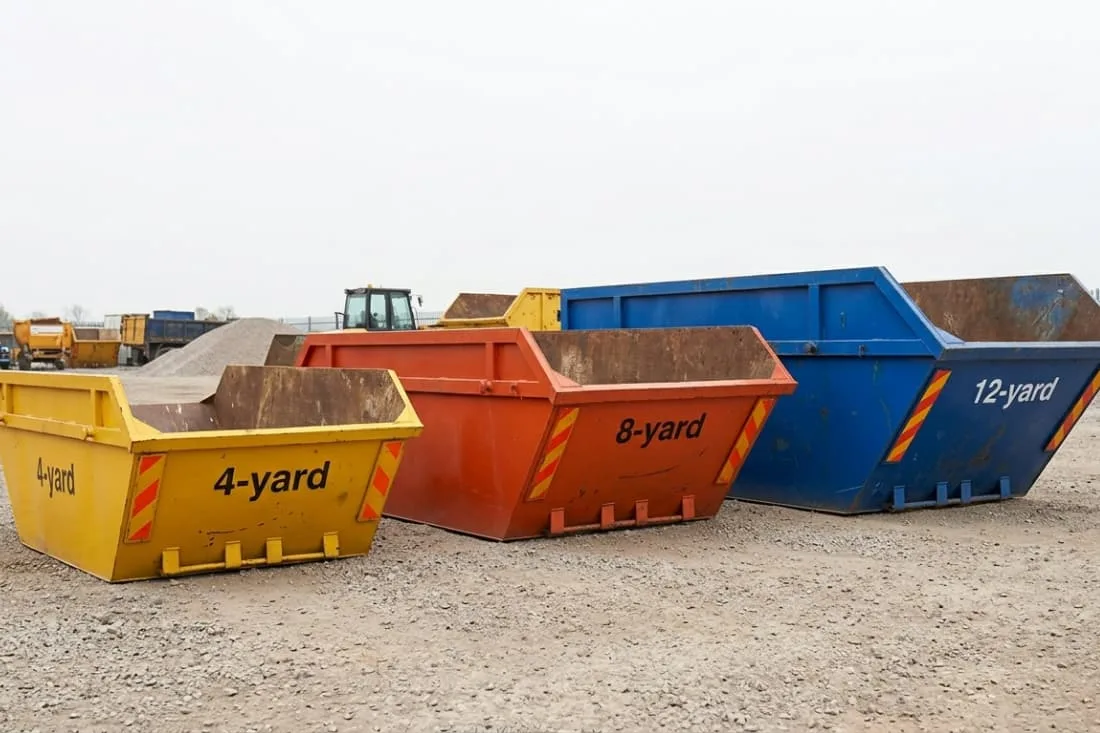
A builders skip is a large, open-top metal container designed for heavy construction and demolition waste.
Builders use them for commercial contractor skip hire to collect rubble, timber, soil, plasterboard, and general site debris in one place. This keeps the work area tidy and improves safety.
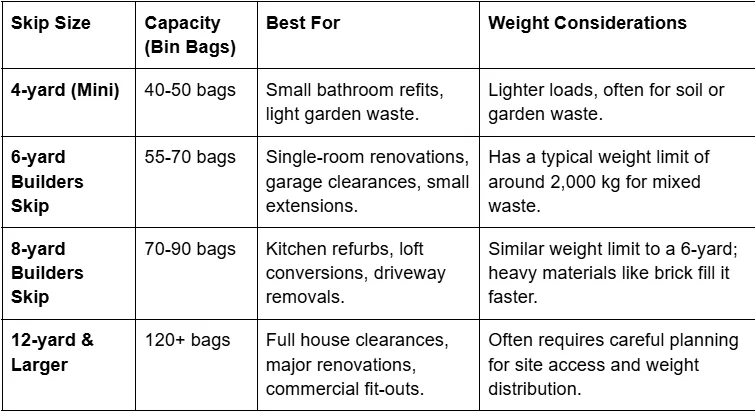
The size you need is measured in cubic yards, which refers to its volume capacity. Choosing the right size is the first step to managing your costs and site logistics efficiently.
The table below shows the most common skip sizes for builders, what they hold, and the types of projects they suit.
Skip Hire Costs for Builders in the UK
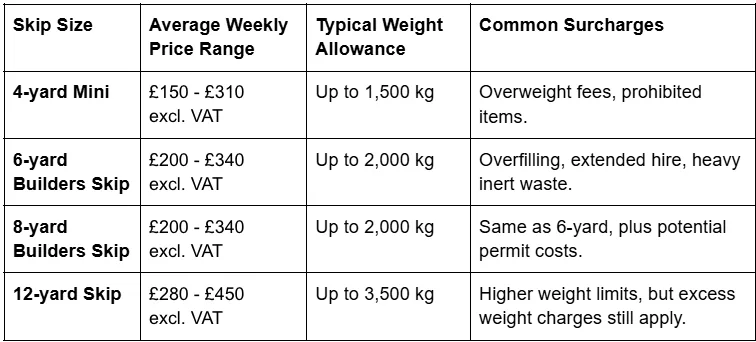
Builders skip hire in the UK usually costs between £200 and £340, excluding VAT, for a standard hire period. The final price depends on several key factors, which makes builders skip hire cost planning important for staying within budget.
The main ones are the skip size, your location, whether you need a road permit, and the type of waste you are disposing of.
Prices in London and the South East are typically 10-20% higher than in more rural areas or in the north of England.
The table below gives a rough guide to average weekly prices, but you should always get a local quote for an accurate figure.
Extra charges on a skip hire bill can quickly eat into your project margin. These fees usually come from a few common situations.
The skip hire company will weigh the skip at their facility. If it exceeds the agreed weight limit, they will charge an extra fee per kilogram. Overfilling the skip so waste is above the rim is also a problem, as it is unsafe to transport.
Other charges can come from putting in prohibited items like tyres or asbestos, which need special disposal. Perhaps the most frustrating charge is for continuous hire fees, which apply if the skip is not collected on the agreed date and is left on site for extra weeks.
Permit Requirements for a Builders Skip in the UK
Builders need a council permit when a skip is placed on a public highway, which includes the road or pavement. If the skip sits entirely on private land, like a driveway or the building site itself, you usually do not need a permit.
As noted by City of Doncaster Council
"Regulations relating to the depositing of a builder's skip on a highway are contained in Section 139 of the Highways Act 1980. Under these the Council may grant permission to deposit a builder's skip on a highway within its boundaries, subject to certain conditions." - City of Doncaster Council
The rules and costs for permits vary by local council. In areas like Berkshire or Buckinghamshire, you must plan ahead for the permit process. The skip hire company can often arrange this for you, but you need to request it when you book.
Failing to get a required permit can lead to fines from the council. They may also require you to place safety lights and cones around the skip if it is on the road at night. It is a straightforward part of the job, but one that needs attention early in your planning.
What to Do If Your Skip Isn't Collected
A missed collection can cause real headaches on a building site. It blocks access, leaves waste sitting around, and can trigger extra weekly hire charges from the skip company.
Research from Peterborough City Council shows
"Your waste is legally your responsibility until it is disposed of correctly. If your waste is found fly-tipped, you could be fined or prosecuted." - Peterborough City Council
First Step: Contact the company directly to rearrange the collection.
If Unresponsive: Remind them of their duty of care as a licensed waste carrier.
Serious Cases: Report the issue to the Environment Agency, which regulates waste companies.
To avoid this, always get the agreed collection date confirmed in writing when you book the skip.
What Can and Cannot Go Into a Builders Skip
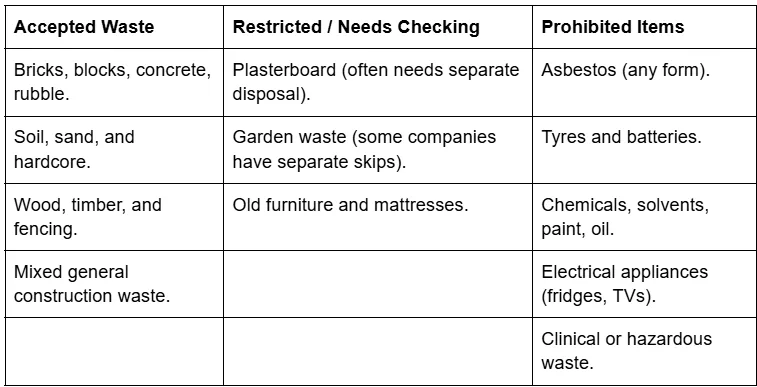
Builders skips are designed for typical construction and demolition waste. This includes materials like brick, concrete, tiles, wood, soil, and rubble. You can also put in non-hazardous packaging and general site rubbish.
However, there is a strict list of items that are not allowed in a standard skip because they are hazardous or need special processing. Putting these in can lead to refused collection or large extra fees.
Why Do Builders Separate Waste Into Multiple Skips?
On larger projects, it often makes financial sense to use separate skips for different waste types. This is called waste segregation.
While it might seem easier to throw everything into one mixed waste skip, separating materials like clean brick, wood, and metal can significantly reduce disposal costs.
Recycling facilities charge less for clean, separated materials than for mixed loads that need sorting.
Some builders report savings of 10-25% on their waste costs by taking this approach. It also helps ensure you are complying with waste regulations and improves your site's environmental responsibility.
Using Skip Hire to Improve Site Safety for Builders
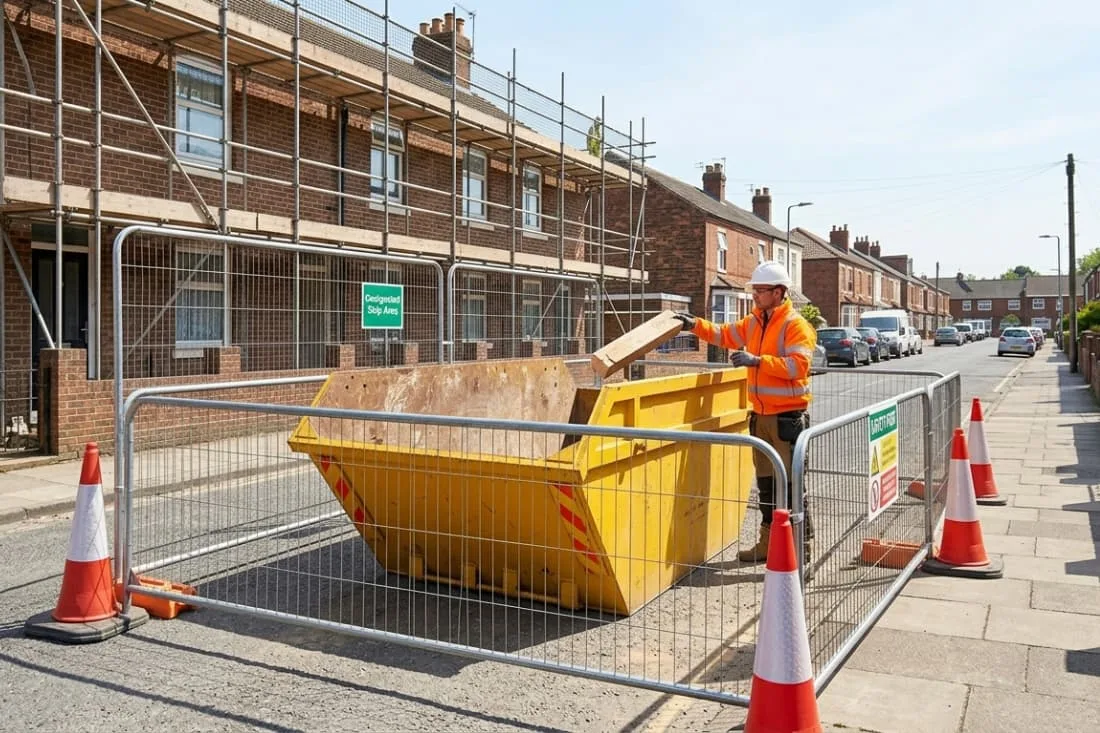
A well-placed skip is a key tool for maintaining a safe and efficient building site. By providing a dedicated place for all waste, it prevents debris from being scattered across walkways and work areas. This directly reduces tripping hazards for your team and anyone else on site.
It also helps control dust and keeps the site more organised, which allows work to continue smoothly. Many builders find that using a skip can save 15-30% of the time usually spent on managing and moving waste, letting them focus on the construction work itself.
Comparing One Large Skip to Multiple Smaller Skips
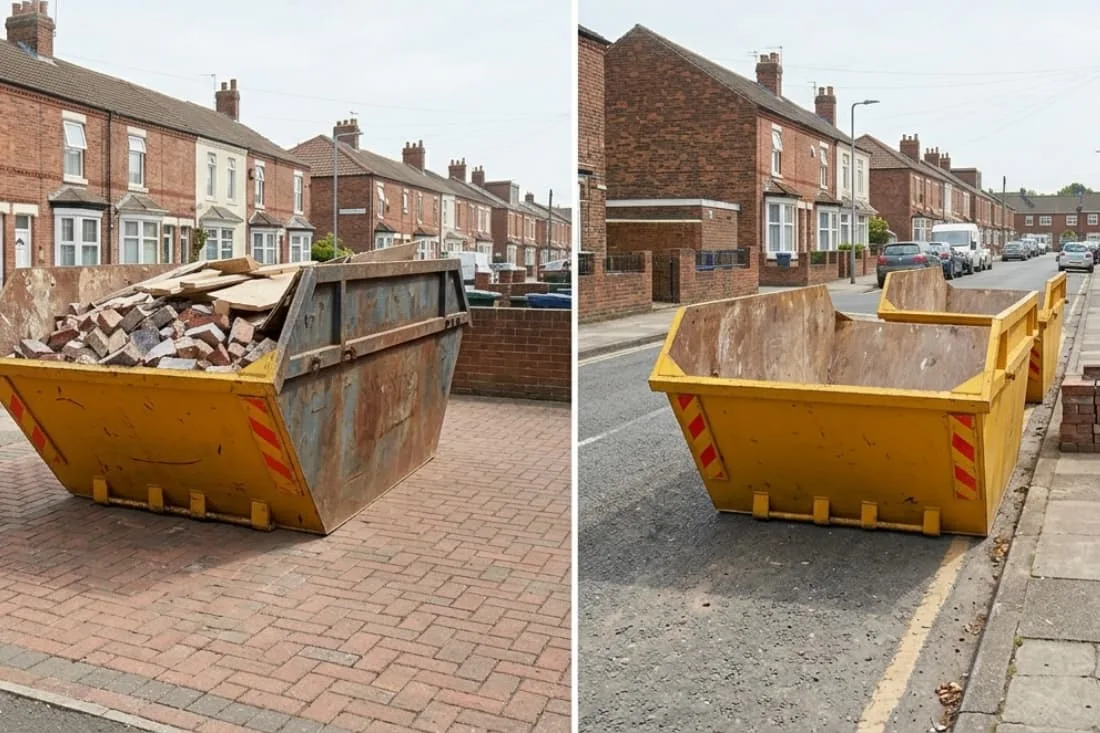
The choice between one large skip or several smaller ones depends on your specific project.
A single large skip, like a 12-yard or a roll-on/roll-off (RO/RO) container, can be more cost-effective for a big, single-phase job where waste is generated quickly. It means one delivery and one collection.
However, multiple smaller skips offer flexibility. They can be placed in different zones on a large site, reducing the distance workers need to carry waste. They also allow for waste segregation, which can lower costs.
For a phased project or a site with limited access for large vehicles, multiple smaller skips are often the better choice.
Common Skip Hire Mistakes for Builders
Even experienced builders can run into problems with skip hire if they overlook a few key details. The most common mistakes are easy to avoid with a bit of planning.
Underestimating Waste: This leads to overfilled skips or needing a second hire.
Ignoring Weight Limits: Heavy materials like concrete can easily exceed the 2,000 kg allowance on an 8-yard skip.
Not Applying for a Permit: Forgetting to get a road permit in time causes delays.
Not Getting Confirmation: Not getting the collection date in writing can lead to disputes and extra hire fees if the skip is not taken away on time.
Smart Skip Hire Planning for UK Builders
Good planning turns skip hire from a potential problem into a smooth part of your project workflow.
Steps for Effective Skip Hire Planning
Estimate Waste: Accurately calculate the volume and type of waste your job will create.
Book Early: Book the skip well in advance, especially during busy periods like spring and summer.
Ask About Rates: For long-term projects or multiple jobs, ask the hire company about fixed weekly pricing and long term skip hire solutions for multi-skip contracts.
By treating skip hire as a planned logistics item, you control costs and maintain a cleaner, safer, and more professional site.
FAQ
Builders skips are commonly used for kitchen renovations, garden renovation work, and full home renovation projects. An 8-yard skip is often called Britain's most popular skip size because it can handle bulky waste, black bags, and general waste materials from construction sites. Larger commercial projects or demolition projects may require Roll-on Roll-off Skips because they hold more wheelbarrow loads and heavier waste.
Builders may need approval from the local authority or Highway Authority when placing Skip Hire containers on public roads instead of private property. Permit rules can vary across UK cities and geographic locations. Many skip hire services also use traffic cones and clear safety markings to improve public safety near construction sites and utilities services.
Most skip hire services do not allow hazardous waste such as asbestos, chemicals, electrical equipment, or certain industrial waste materials inside standard skips. Some waste types require separate waste disposal procedures at a Waste Transfer Station or Recycling Facilities. A licensed waste carrier will usually explain restricted items before delivery to help builders follow environmentally responsible waste management and landfill policy regulations.
Builders can reduce waste disposal costs by separating domestic waste, organic waste, and recyclable waste materials during site clearance work. Using wheelie bins for lighter waste and reserving Builders skips for bulky waste can improve eco-friendly waste management. Many commercial skip hire services also transport waste to an advanced recycling facility or Material recycling Facility to reduce Carbon Footprint and landfill use.
Builders should check the skip size, Weight Limit, site access, and waste transfer requirements before booking Skip Hire UK services. It is also important to confirm customer service quality, WAMITAB standards, and ISO 14001 Accreditation for environmentally responsible waste management service providers. Companies with YEARS OF EXPERIENCE are usually better prepared to manage domestic skip hire, commercial skip hire, and larger building projects safely.
Keep Your Project Moving with Smarter Skip Hire
Builders skip hire is not just about waste removal, it directly affects your budget, schedule, and site safety. Choosing the right size, planning for permits, and understanding weight limits helps avoid delays, extra charges, and unnecessary stress on site.
The cheapest option is not always the best value. Reliable service and clear communication often save more time and money in the long run.
Start your search skip hire to compare verified local providers across the UK and find the right solution for your project.
References
Related Articles
Filed under:
Commercial Skip Hire