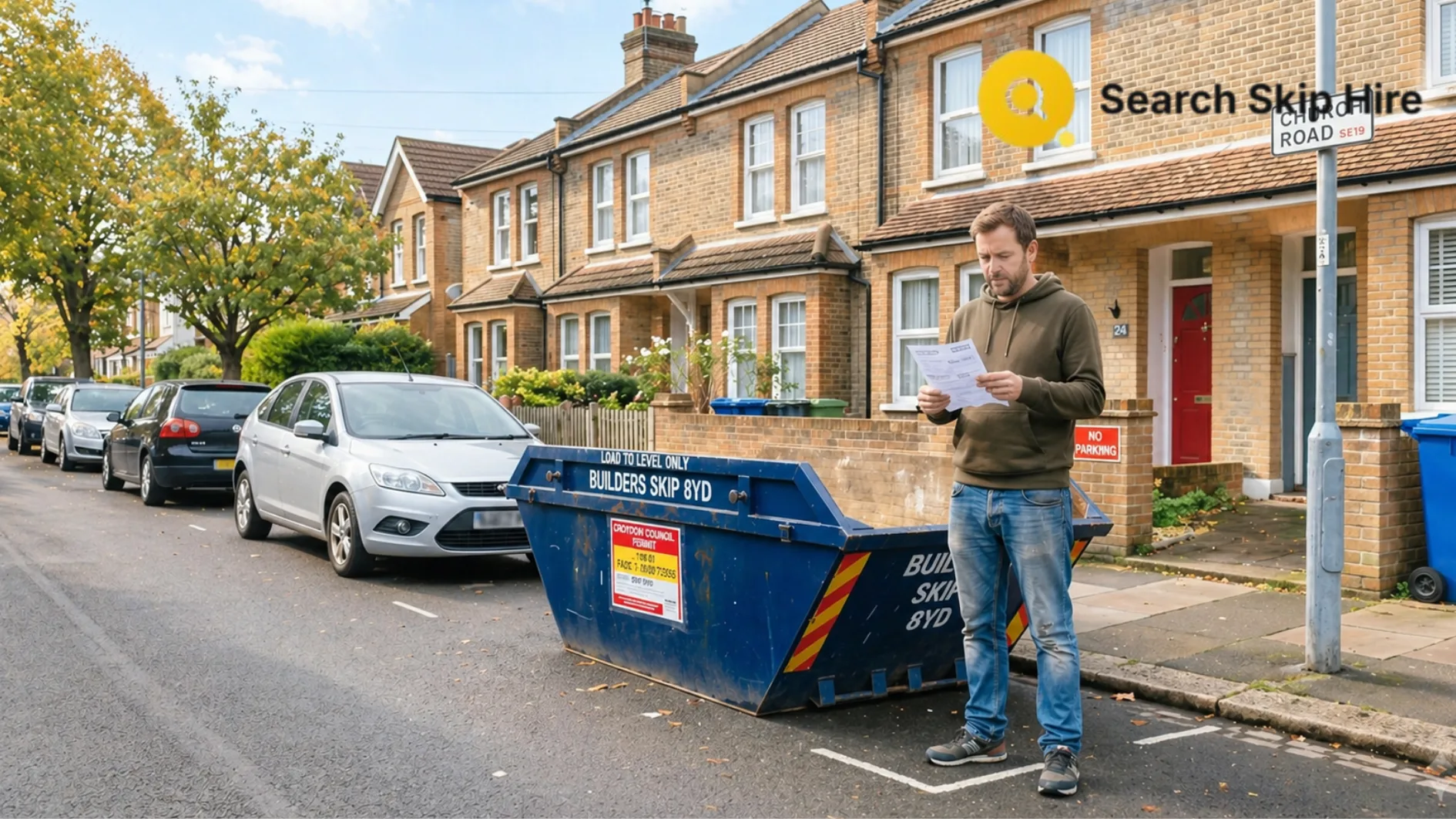
If you want to hire a skip in the UK, there are legal rules you need to follow, and yes, they apply whether you're putting it on your driveway or out on the street. The rules cover everything from permits and waste carrier licences to how the skip must be marked for safety.
Getting this wrong can lead to fines, so it's worth understanding what's required before you book. Keep reading to find out exactly what the law expects from you and your skip hire company.
Quick Guide: Skip Hire Legal Essentials
Before hiring a skip in the UK, these are the core legal points you need to understand to stay compliant and avoid fines.
You need a permit to place a skip on a public road. Your skip hire company usually handles this, but it is your responsibility to make sure it is in place before the skip is delivered.
The company you hire must be a licensed waste carrier. It is illegal under the Environmental Protection Act 1990 to use an unlicensed operator for waste removal.
You must not put prohibited items in a skip. Hazardous waste, asbestos, and certain other materials are banned from standard skips and must be disposed of separately.
Do You Need a Permit to Hire a Skip?
Whether you need a permit depends on where the skip will be placed. The rules are straightforward once you know them.
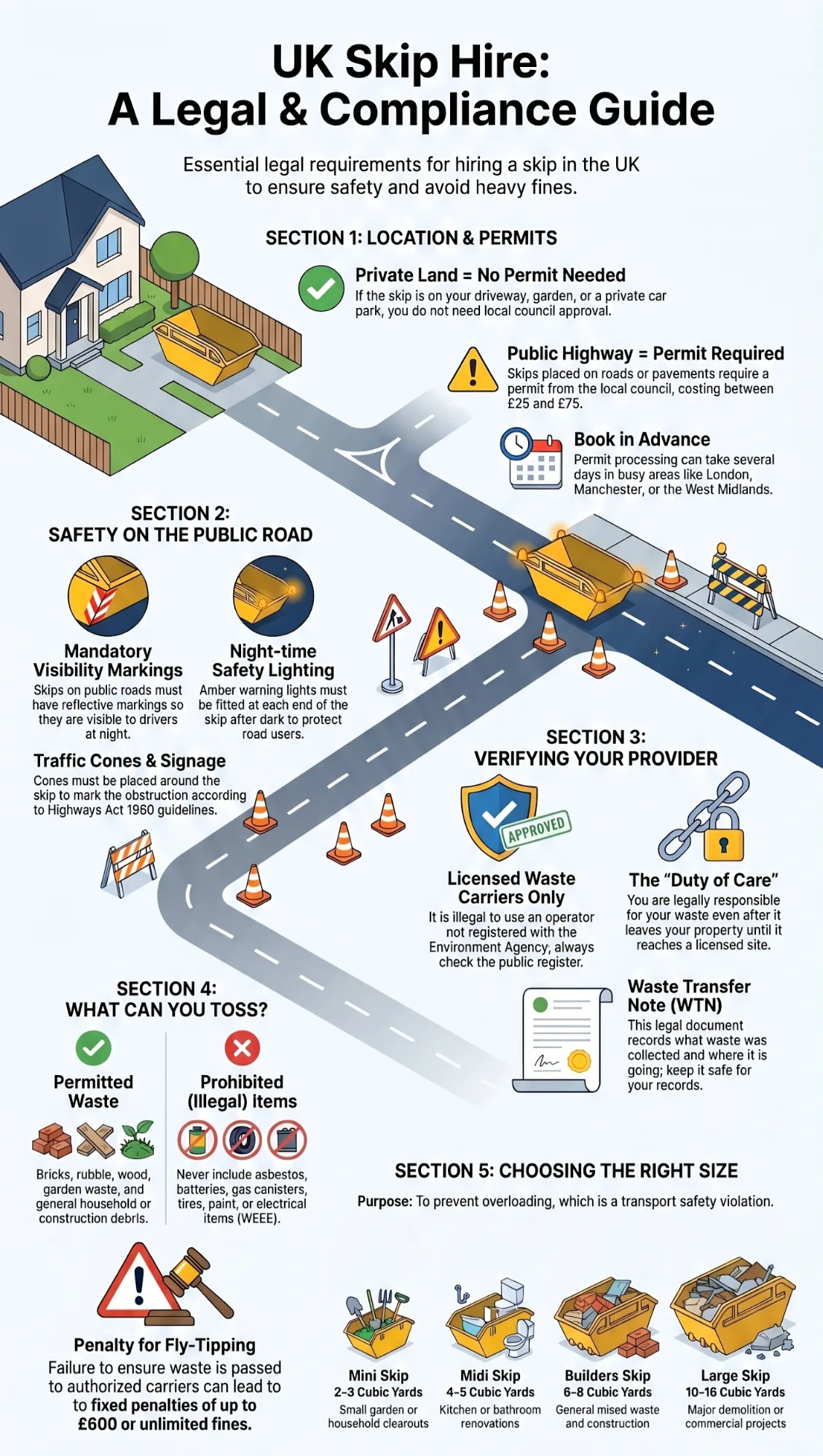
If the skip is going on private land such as your driveway, your garden, or inside a private car park, you do not need a permit. The land is yours, so local council approval is not required.
If the skip needs to go on a public highway, including the road outside your house or on the pavement, you will need a skip hire permit from your local council. This is sometimes called a street permit or pavement permit.
Most skip hire companies apply for this on your behalf as part of the booking process, but it is worth confirming this when you place your order.
In areas like Greater London, the permit process can take a few days, so it helps to book ahead rather than leaving it last minute. The same applies in busy urban areas across Greater Manchester and West Midlands, where councils process a high volume of applications. Permit fees vary by council, but most fall somewhere between £25 and £75 depending on the area and how long you need the skip.
Permits usually cover a set period, often 7 days, and can be renewed if you need the skip for longer. If your skip stays on the road beyond the permitted duration without renewal, you may face fines from the council.
What Makes a Skip Legal on a Public Road?
Placing a skip on a public highway comes with specific safety requirements under the Highways Act 1980 and local authority guidelines. These rules exist to protect other road users, pedestrians, and cyclists.
A legally placed skip on a public road must meet the following requirements, all of which a good skip hire company should handle automatically:
Reflective markings must be displayed on the skip so it is visible to drivers, especially at night.
Safety lights must be fitted at each end of the skip after dark. These are usually amber warning lights.
Traffic cones must be placed around the skip to mark the obstruction and warn approaching drivers.
Road signage may also be required depending on the location and the council's specific conditions.
These are not optional extras. They are legal requirements. A reputable skip hire company will supply and fit all of these as standard when delivering a skip to a public road. If you are ever unsure, ask your provider to confirm what safety equipment is included with delivery.
Waste Carrier Licence: Why It Matters

One of the most important legal requirements in the UK skip hire industry is the waste carrier licence. Any company that collects, transports, or disposes of waste must be registered with the Environment Agency.
Under the Environmental Protection Act 1990, it is an offence to use an unlicensed waste carrier. As the person hiring the skip, you also have a duty of care, meaning you are responsible for making sure your waste is handled legally, even after it leaves your property.
"Householders and businesses can protect themselves by asking waste collectors for their waste carrier's registration number and waste transfer note before handing over any rubbish.” – GOV.UK
We always recommend checking that your skip hire company is a registered waste carrier before you book. You can verify this on the Environment Agency's public register, which is freely available online. Using an unlicensed operator can leave you exposed to prosecution and fines, even if you had no idea the company was not compliant.
When your waste is collected, a licensed operator should provide you with a waste transfer note. This is a legal document that records what waste was collected, where it came from, and where it is going. Keep this document safe, as you may need it if your waste disposal is ever questioned.
What Can and Cannot Go in a Skip?
Not everything is allowed in a skip. There are clear legal restrictions on what can be placed inside one, and breaking these rules can result in serious penalties.
Most standard skips, whether a mini skip, a midi skip, a builders skip, or a large skip, can accept general household waste, garden waste, renovation waste, commercial waste, and construction waste such as bricks, rubble, and wood.
The following items are not permitted in a standard skip, and you must arrange separate licensed disposal for each of them:
Asbestos requires specialist licensed disposal and must never go in a general skip.
Hazardous waste includes chemicals, solvents, paint, and similar materials.
Electrical items and appliances fall under WEEE regulations and need separate recycling.
Tyres are classed as controlled waste and banned from standard disposal routes.
Batteries and gas canisters pose fire and explosion risks.
Medical or clinical waste requires dedicated clinical waste disposal.
Soil contaminated with pollutants needs environmental testing before disposal.
Placing prohibited items in a skip puts you and the skip hire company at legal risk. It can also result in your skip being refused at the disposal site, which may mean additional charges or delays. If you have items that cannot go in a skip, ask your hire company for advice on the best way to dispose of them legally.
Environmental Permits and Disposal Sites

Your skip hire company must hold an environmental permit to operate legally. This permit, issued by the Environment Agency, allows them to manage, transfer, and dispose of waste at licensed sites.
All waste collected by a licensed operator must go to an authorised disposal site. This might be a licensed transfer station, a recycling centre, or a landfill site that has the appropriate environmental permit.
Dumping waste anywhere other than an approved site is fly-tipping, which is a criminal offence under the Environmental Protection Act 1990. Fly-tipping can result in unlimited fines or even imprisonment for the most serious cases.
"Householders have a duty of care to ensure their waste is passed to authorised carriers. They can receive fixed penalty notices of up to £600 if they fail to take reasonable measures and their waste is later fly-tipped.” – UK Parliament
We take our responsibilities seriously when it comes to environmental compliance. Waste should be sorted and sent to the most appropriate facility, and skip companies are increasingly required to meet recycling rates set by national targets. Many operators now aim to divert as much waste as possible away from landfill through waste segregation at the transfer stage.
Operator Licences and Transport Compliance
Skip lorries, the vehicles used to deliver and collect skips, must comply with UK transport law. Drivers are required to hold the appropriate licence for the vehicle class. Operators must hold a goods vehicle operator licence if their vehicles exceed 3.5 tonnes, which most skip lorries do.
There are also rules around driver hours and the use of tachographs to monitor driving time and rest periods. These regulations fall under UK transport compliance law and are enforced by the Driver and Vehicle Standards Agency (DVSA). Reputable skip hire companies are fully compliant with these requirements as part of their day-to-day operations.
Dealing With Neighbours and Nuisance Prevention
When a skip is placed on a public road, there are a few practical and legal considerations around nuisance prevention. While it is legal to place a skip on the highway with the correct permit, you should still let your neighbours know before the delivery, especially if the skip will affect parking or access.
Councils can issue nuisance orders if a skip causes an unreasonable obstruction beyond the permitted footprint. This is rare when the correct permit is in place and the skip is properly marked, but it is worth being aware of.
If you are based in areas like Kent or other parts of the South East where residential streets can be narrow, it helps to think carefully about skip placement before booking. Your skip hire company can advise on the best size and position to minimise disruption and stay within the law.
Insurance and Liability
A legitimate skip hire company will carry appropriate insurance cover to protect against accidental damage during delivery and collection. This includes damage to vehicles, property, or road surfaces that may occur when a skip lorry manoeuvres in tight spaces.
As the hirer, you should also make sure that you understand the terms of your agreement. Most companies include clear guidance on what they are liable for and what falls to the customer. Overloading a skip, which means placing more waste than the weight limits allow, can void some terms and create liability issues if the load shifts during transport.
Always check the loading limits before you start filling your skip. Most skip hire companies provide guidance on weight restrictions as part of the booking process.
Skip Sizes and Legal Compliance
Choosing the right skip size is not just about convenience. It also affects legal compliance. An overloaded skip cannot legally be transported on public roads. Waste must not be piled above the rim of the skip and must be within the stated weight restrictions for the vehicle carrying it.
Here is a quick overview of common skip sizes, their typical capacity, and the jobs they are best suited to:
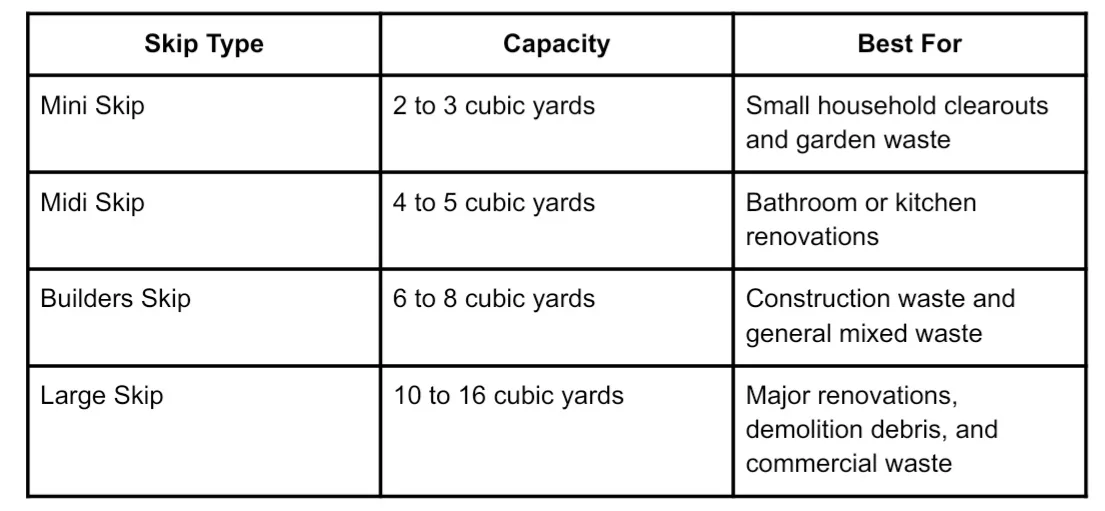
If you are unsure which size to go for, it is always better to size up slightly rather than risk overfilling, which creates legal and safety problems during transport.
Final Thoughts on Skip Hire Legal Requirements in the UK
Understanding skip hire legal requirements in the UK does not have to be complicated. The key things to remember are: get the right permit if your skip is going on the road, use a licensed waste carrier, keep your waste transfer note, and never put prohibited items in your skip. These steps protect you legally and make sure your waste is handled responsibly.
Whether you are clearing out a garden in Greater Manchester, renovating a kitchen in Kent, or managing a building project in West Midlands, the rules are broadly the same across the UK, though local councils may have their own permit fees and processing times.
If you are ready to book a skip and want a straightforward, compliant service, we can help. Head over to Search Skip Hire to find local skip hire options across the UK, compare sizes, and get your booking sorted quickly.
FAQ
No, you only need a permit if the skip is placed on a public road or pavement. If it is kept entirely on private land, such as a driveway or garden, a permit is not required.
Most skip hire companies will arrange the permit on your behalf, but the legal responsibility still sits with you to ensure it is in place before the skip is delivered.
Using an unlicensed waste carrier is illegal under the Environmental Protection Act 1990. You could face fines or prosecution, even if you were unaware the company was not properly registered.
This depends on the permit issued by your local council. Most permits last around 7 days, but they can usually be extended if needed by renewing the permit.
You should arrange separate disposal through a licensed provider. Your skip hire company can often advise or direct you to appropriate services for hazardous or restricted waste.
References
https://www.gov.uk/government/news/successful-crackdown-on-illegal-waste-carriers-in-east-anglia
https://commonslibrary.parliament.uk/research-briefings/sn05672/
Related Articles
Filed under:
Skip Permits