
You need a skip permit when you plan to place a skip on a public highway, pavement, or any land managed by your local council. If the skip stays on your own private driveway or private land, no permit is needed.
It really is that simple as a starting point, but there is quite a bit more to understand before you book a skip, especially if you are working in a built-up area. Keep reading and we will walk you through everything.
Skip Permits in a Nutshell
Before we get into the detail, here are the three most important things to know about skip permits in the UK, a quick snapshot of when you need one, who handles it, and what can vary:
You only need a permit for public land. If the skip sits entirely on your private property, no permit is required.
Your skip hire company usually handles the permit for you. Most reputable skip hire companies apply to the council on your behalf, though the cost is passed on to you.
Permit rules vary by local council. Costs, timescales, and conditions differ depending on where you are in the UK, so it pays to check with your local highways authority.
What Counts as a Public Highway?
Understanding where your skip will actually sit is the first step. A lot of people assume their front garden or the strip of land outside their house belongs to them, but that is not always the case.
The public highway includes all of the following areas:
The road itself, including any lane markings
The pavement or footpath running alongside the road
The grass verge between the pavement and the road
Any adopted street maintained by the local council
If your skip needs to go on any of these surfaces, you will need a highway skip permit before the skip is dropped off. Placing a skip on the highway without one is a criminal offence under the Highways Act 1980.
"A builder's skip shall not be deposited on a highway without the permission of the highway authority for the highway.” – Legislation GOV. UK
This means fines can fall on both you and your skip hire company.
When You Do Not Need a Skip Permit
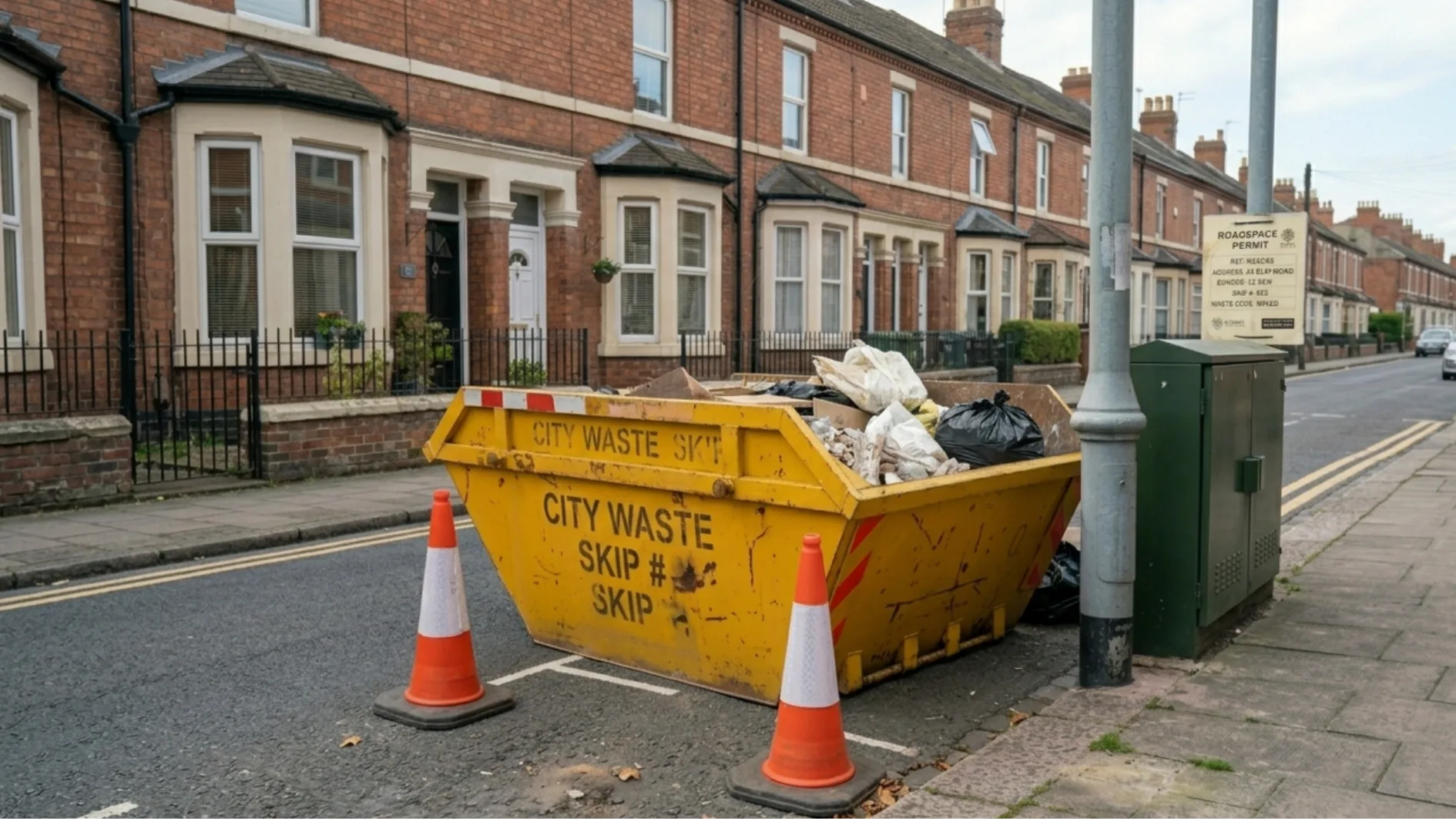
There are situations where a permit is not required at all, and it is worth checking whether your property qualifies before going through the application process.
You will not need a permit if the skip is being placed in any of these locations:
Your private driveway, entirely within your property boundary
A private car park that you own or have permission to use
Land you own that is not accessible to the public
An off-road construction site with its own private access
The key word here is private. As long as the skip does not touch, block, or overhang a public road or pavement, you are in the clear. If you are unsure about your boundary, your skip hire company can usually advise you based on the delivery address.
To make this even clearer, here is a quick comparison of common placement scenarios:
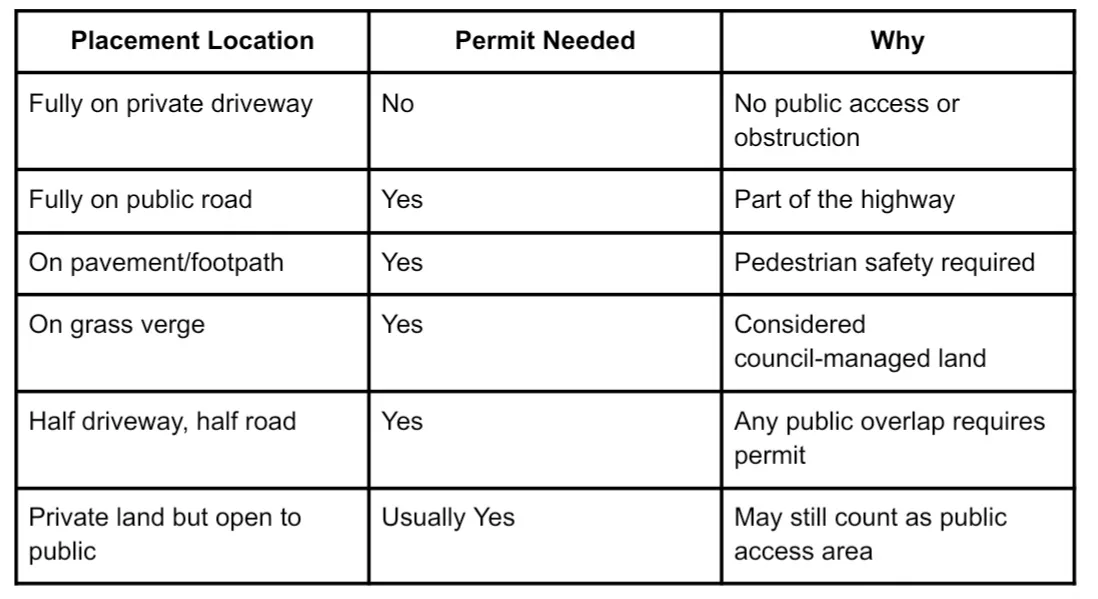
How to Apply for a Skip Permit
The process for getting a skip permit is fairly straightforward, and in most cases your skip hire company will manage it on your behalf. That said, it helps to understand what is involved so you know what to expect.
Here is a general outline of how the permit process works:
Your skip hire company submits an application to the local highways authority or council.
The council reviews the request, checking for any conflicts such as nearby roadworks, bus lanes, or access restrictions.
A permit is issued, though how long this takes varies by council.
The permit is displayed on or near the skip during its time on the highway.
The skip must be collected before the permit expires, or a renewal must be requested.
Some councils have online portals for permit applications, while others still operate by phone or post. In areas like Greater London, the process tends to be more formalised due to the volume of applications, and lead times can be longer. In places like Kent or the West Midlands, timescales may be shorter, but the conditions attached to the permit can still vary significantly.
How Much Does a Skip Permit Cost?
Skip permit fees are set by individual local councils, so there is no single fixed price across the UK. Across the 197 UK highway authorities we have checked, half charge between £40 and £90, with a typical figure of about £62, though they run from £12.40 to £260.
Some councils also charge differently based on the type of road or the level of traffic disruption caused by the skip placement. Busy town centres or major residential roads tend to attract higher fees than quieter side streets.
Your skip hire company will usually include the permit fee as part of your overall quote, or they will list it as a separate line item. Either way, it is worth asking upfront so there are no surprises when the invoice arrives.
Skip Permit Conditions You Must Follow
Getting a permit approved does not mean you can place the skip wherever you like on the highway. Every permit comes with a set of conditions that must be followed throughout the hire period.
These conditions are in place to protect pedestrians, road users, and the general public.
"The Highway Authority issues skip licences, and it seeks to maintain the safety of the public and minimise the obstruction caused by a skip." – Lancashire County Council
Failing to comply can result in the permit being revoked and the skip being removed at your expense.
Here are the standard conditions that apply to most highway skip permits in the UK:
Warning lights must be attached to the skip when it is in position on the road, particularly at night
Reflective markings or yellow ends must be clearly visible on the skip at all times
The skip must not block access to drains, fire hydrants, or utility covers
Clear pedestrian access must be maintained on the pavement at all times
The skip must not be placed within a certain distance of road junctions, crossings, bus stops, or cycle lanes
The skip must not obstruct parking bays, loading zones, or emergency vehicle access routes
Drains and gullies must remain accessible throughout the hire period
Your skip hire company is responsible for ensuring the skip meets these requirements when it is delivered. However, if something changes during the hire period, for example, if the skip shifts position or a light gets damaged it is your responsibility to report it.
How Long Does a Skip Permit Last?
Most highway skip permits are issued for a set number of days, commonly between one and four weeks. The exact duration depends on what your council allows and what you apply for.
If you need the skip for longer than the original permit period, you will need to apply for a renewal before it expires. Leaving a skip on the highway after the permit has run out is treated the same as having no permit at all, which can result in fines and forced removal.
When planning your project, it is worth being realistic about how long you will need the skip. It is better to apply for a slightly longer permit than to scramble for a renewal at the last minute, especially if your council has a slower processing time.
Special Situations That Affect Permit Approval

There are certain locations and circumstances where getting a skip permit can be more complicated, or where approval may be refused altogether. It is worth being aware of these before you book.
The following situations can affect permit approval:
Yellow lines: Placing a skip on double yellow lines is generally not permitted, though some councils may grant exceptions. Single yellow lines may be allowed depending on time restrictions.
Near bus lanes or cycle lanes: Skips that would partially block a bus or cycle lane are often refused.
Near pedestrian crossings: Most councils will not grant a permit for a skip within a set distance of a zebra crossing or pelican crossing.
Active roadworks nearby: If the council already has roadworks planned in your area, they may refuse a skip permit to avoid additional obstruction.
Residential permit zones: In areas with controlled parking, skip placements can affect existing permit holders, and councils will factor this in.
If your planned location raises any of these concerns, your skip hire company can often suggest an alternative drop point that is more likely to be approved.
Tips for a Smooth Skip Hire Experience
A little preparation goes a long way when it comes to skip hire, particularly if you need a permit. Here are some practical things to keep in mind:
Book early if you know your project start date, so the permit has time to be processed
Confirm the permit is in place before the skip is delivered, do not just assume it has been arranged
Check the skip has proper markings and lights when it arrives, especially if it will be on the road overnight
Keep the skip tidy and do not overfill it, as this can create a road safety hazard
Clear the space where the skip will be placed, especially if cars are regularly parked there, you may need to notify neighbours in advance
Do not place prohibited items in the skip, as this can cause issues with disposal and potentially your permit
Whether you are looking for skip hire in Greater Manchester, arranging a house clearance in Kent, or managing a small renovation in the West Midlands, these basics apply across the board.
Frequently Asked Questions
No. A permit is only required if the skip is placed on public land such as a road, pavement, or grass verge. If the skip is fully within your private property boundary like a driveway you do not need one. Even a small overlap onto public land means a permit is required.
In most cases, your skip hire company will handle the application for you. They deal directly with the local council and ensure everything is approved before delivery. The fee is usually included in your quote or listed separately, so it is worth confirming upfront.
How long a permit takes to be approved varies depending on the council and location, so it is always best to arrange your skip in advance to avoid delays.
Placing a skip on public land without a valid permit is a legal offence. You may face fines, and the council can arrange for the skip to be removed. In some cases, both you and the skip hire company could be held responsible.
Yes, most councils allow you to extend your permit if needed. You will need to request a renewal before the current permit expires, usually through your skip hire provider. Leaving a skip in place after expiry is treated the same as having no permit.
Final Thoughts on Skip Permits: What You Need to Remember
Getting a skip permit is not complicated, but it does require a bit of planning. The most important thing to remember is that any skip placed on a public highway, including the road, pavement, or verge requires a permit from your local council under the Highways Act 1980. Without it, both you and your skip hire company could face fines or enforcement action.
In most cases, your skip hire company will handle the permit application for you. But it is always worth asking upfront, confirming that the permit has been approved before the skip is dropped off, and making sure the conditions of the permit are being met throughout your hire period.
If you are ready to book a skip or just want to check what is available in your area, we can help. Find skip hire near you at Search Skip Hire and get a quick quote for your job, whether it is a small domestic clearance or a larger commercial project.
References
Related Articles
Filed under:
Skip Permits