
A council skip permit is required when we place a skip on a public road, pavement, or verge in the UK. The local authority must approve the placement before delivery to make sure it is safe and does not block access or traffic.
This permit confirms that the skip meets legal and safety rules set by the council. Without it, we may face fines or have the skip removed.
The process is usually simple when we understand the steps. Keep reading to see how it works and how we can avoid delays.
Council Skip Permit Process Key Points
Understanding the council skip permit process helps us avoid delays, fines, and confusion when arranging skip hire for our project.
We must apply for a permit if the skip is placed on public land
The council reviews safety, location, and documentation before approval
Most permits are time-limited and must follow strict conditions
What Is a Council Skip Permit in the UK?
A council skip permit is a legal requirement that allows us to place a skip on public land such as roads or pavements. It helps keep public spaces safe and ensures our project does not disrupt daily use of roads or walkways.
Definition Under the Highways Act 1980 Section 139
This law gives councils the authority to control skips placed on highways and make sure public spaces stay safe and accessible.
Before we place a skip on public land, the council needs to confirm that it meets basic safety and placement standards.
It applies to roads, pavements, and public verges
The council highways team manages approvals
The permit ensures proper placement and visibility
When You Need a Skip Permit
A skip permit is only required when the skip is placed on public land, such as a road or pavement, while placement on private property is usually exempt and follows simpler rules.
It is important to check the exact boundary of the placement area to avoid applying for a permit unnecessarily, as public locations always require permission and busy or restricted zones may have additional conditions; as reported by Bedford Borough Council,
“Skip licences are required if the skip is to be placed on the public highway.”
To keep things clear, we can follow these general rules:
Public roads and pavements always require permission
Private land placements are usually exempt
Busy or restricted areas may have additional rules
Step-by-Step Council Skip Permit Application Process
The permit process follows a clear structure, and once we understand each step, it becomes easier to manage from start to finish.
Taking a little time to prepare before applying can help us avoid delays and make the process smoother overall.
Step 1 – Check Eligibility & Site Conditions
We need to look at the location carefully and make sure it is suitable for placing a skip safely.
This step helps us avoid problems later, especially in areas with limited space or heavy traffic.
Narrow roads may be restricted
Double yellow lines usually prevent placement
Pedestrian and vehicle access must remain clear
Step 2 – Choose a Council-Approved Skip Provider
Working with a licensed provider helps us stay compliant and reduces the chance of mistakes during the application.
Many providers also help with the permit process, which can save time and effort.
The provider must be properly licensed
They often handle the permit application for us
Waste carrier licence proof is required
Step 3 – Submit Application to Local Authority
We can submit the application in a few different ways depending on how the council operates in our area. For a broader understanding, we can review legal rules, permits and compliance.
Most councils now offer online systems, which makes the process quicker and easier to manage.
Online applications are the most common
Some councils provide downloadable forms
Local highways teams process submissions
Step 4 – Provide Required Documentation
The council needs clear and accurate information before approving a permit, so it is important to prepare documents carefully. It also helps to understand skip hire legal requirements in the UK before applying.
This step is often where delays happen if details are missing or unclear.
Site location plan and measurements
Scale drawings for precise placement
Insurance documents for liability coverage
Step 5 – Pay Permit Fees
We must pay a permit fee, and the cost depends on the council and how long the skip will stay in place. If we are unsure whether a permit applies, we can check when a skip permit is required.
Understanding the cost early helps us plan our budget without surprises.
Typical costs range from £30 to £50 per week
Some councils require a deposit or bond
Fees may vary depending on the area
Step 6 – Await Council Approval
After we submit everything, the council reviews the application and decides if the skip can be placed safely.
It is important to wait for approval before arranging delivery to avoid issues.
Approval times vary by council
Email confirmation is usually provided
Conditions must be accepted before placement
Council Skip Permit Requirements & Conditions
Every permit comes with clear conditions, and following them helps us avoid fines or disruptions during our project.
These rules are mainly focused on safety, visibility, and keeping public areas accessible.
Safety & Visibility Rules
The skip must be easy to see at all times, especially at night, to reduce the risk of accidents.
Simple safety steps make a big difference in keeping both drivers and pedestrians safe.
Safety lights must be used from dusk to dawn
Traffic cones or barriers may be required
Reflective markings must be visible
Skip ends are often painted yellow
Placement & Highway Compliance Rules
Where we place the skip matters, and it should not block or disrupt normal road or footpath use.
Careful placement helps avoid complaints and keeps everything running smoothly.
Pavements must remain accessible
Roads must not be blocked
Emergency access must be maintained
Insurance & Operator Compliance
We also need to make sure all legal and insurance requirements are in place before using the skip.
This protects both us and the public if anything unexpected happens.
Public liability insurance is required
Operators must be registered and compliant
Documentation may be checked by the council
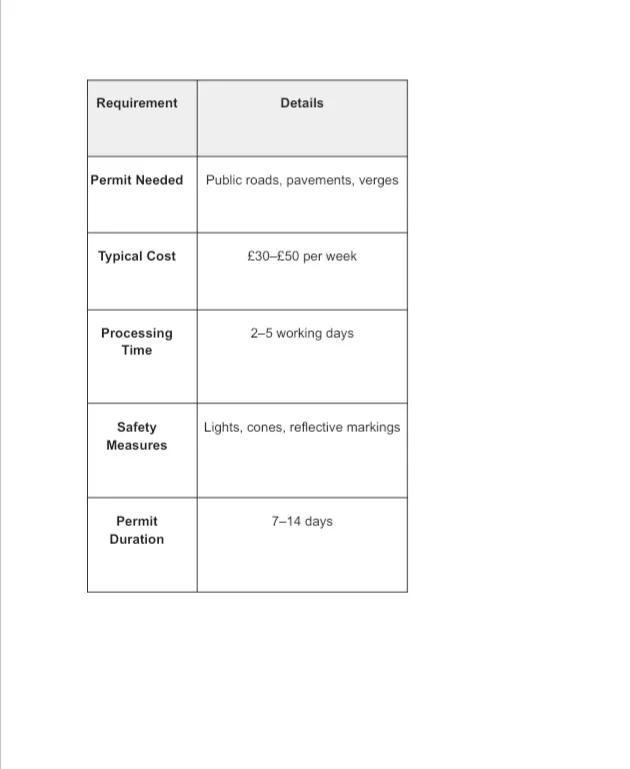
Example of Permit Requirements Overview
Understanding key requirements at a glance helps us prepare properly before applying for a permit.
Processing Time & Permit Validity

Knowing how long approval takes and how long the permit lasts helps us plan our project with better timing.
This is especially useful when we are working with tight schedules or limited access.
How Long Approval Takes
The time needed for approval depends on the council and the location of the skip. Planning ahead gives us enough time to get everything approved before delivery.
According to Leicestershire County Council’s updated 2026 guidelines, applicants
"must apply for a permit at least 3 full working days before the required date of placement on the highway."
Standard processing may take a few days
Some councils off er fast-track approval
Two days’ notice is often required
Permit Duration Rules
Permits are only valid for a set period, so we need to use them within the approved time.
If we need more time, we must take action before the permit expires.
Many permits last 7 to 14 days
Extensions require a new request
Busy areas may have shorter durations
Costs, Fees, and Renewal Procedures
Permit costs and renewal rules can vary, so it helps to understand them before we begin.
This allows us to plan both time and budget more effectively.
Typical Permit Costs in the UK
Costs depend on where we are and how long the skip will stay on public land.
Whether we are looking for services in Greater Manchester, West Midlands, or other parts of the UK, pricing may vary slightly based on local council rules.
Weekly fees are common
Prices vary by council
Additional charges may apply for busy roads
Renewal & Extension Process
If we need the skip for longer, we must request an extension before the current permit ends.
Leaving this too late can cause delays or require a new application.
Extension requests must be submitted early
Additional fees are usually required
Approval is not always guaranteed
Common Restrictions & Special Cases

Some locations have stricter rules, so it is important to check these before arranging skip placement.
Understanding these limits early helps us avoid unexpected issues.
Restricted Areas & Special Permissions
Busy or sensitive areas may require extra approval due to safety concerns.
In areas like Greater London or Kent, restrictions may be stricter due to higher traffic levels.
Traffic light areas may need special permission
City centres often have stricter controls
Narrow roads may limit placement
Private Land vs Public Road Rules
Knowing the difference between public and private land helps us avoid unnecessary permits or fines.
Clear boundaries make the process much simpler.
Private driveways do not need permits
Boundaries must be clearly identified
Misplacement can lead to fines
Compliance, Enforcement & Penalties
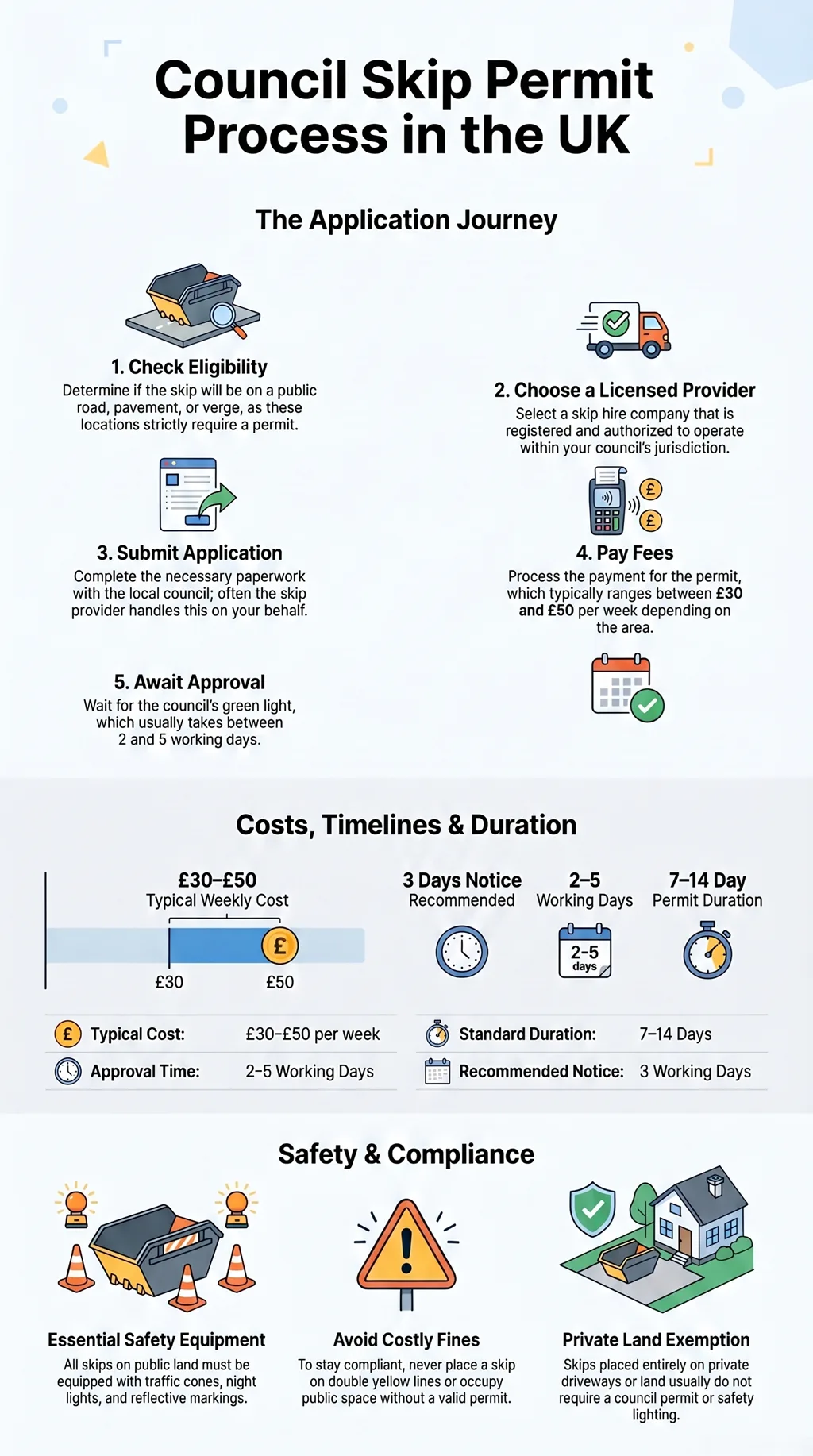
Following the rules is important, as councils take enforcement seriously when skips are placed incorrectly.
Staying compliant helps us avoid extra costs and disruption.
Fines for Unauthorized Skip Placement
Placing a skip without a permit is not allowed and can lead to immediate action.
This is one of the most common mistakes we can avoid with proper planning.
Fines can be issued immediately
The skip may be removed
Additional charges may apply
Council Inspection & Monitoring
Councils may check the skip during the hire period to ensure all conditions are being followed.
These checks help maintain safety across public spaces.
Inspections can happen without notice
Safety measures are reviewed
Non-compliance may lead to penalties
Skip Removal & Legal Action
If rules are not followed, councils have the authority to take further action.
This can include removing the skip and recovering costs from us.
Removal powers come under Highways Act 1980 Section 140
Costs may be charged to us
Legal action is possible in serious cases
Appeals & Support from the Council
If something does not go as expected, there are ways to get help or challenge a decision.
Knowing our options can make the process less stressful.
Skip Permit Appeal Process
We can appeal if a permit is refused, but we need to provide clear supporting information.
Each council may handle appeals slightly differently.
Appeals must include supporting documents
The process varies by council
Response times differ
Contacting the Highways Team
Reaching out to the council early can help us solve problems before they become delays.
Most councils provide simple ways to get guidance.
Phone and email support are available
Online systems are widely used
Guidance is provided for applications
Best Practices for Faster Permit Approval
Following a few simple steps can make the whole process quicker and easier for us.
Good preparation often makes the biggest difference.
How to Avoid Delays
Taking time to prepare accurate information helps the council review our application without issues.
This reduces the chance of back-and-forth communication.
Double-check all documents
Use accurate measurements
Submit early to allow processing time
Working with Skip Hire Providers
Working with a provider helps simplify the process and keeps everything organised.
Using Skip Hire, we can find and compare local skip hire companies across the UK based on our location.
Providers often help manage permits
They understand council requirements
They help reduce errors and delays
FAQ
We only need a permit if the skip is placed on public land such as a road or pavement. Private property does not require one.
Most permits take a few days to process, but some councils offer faster approval depending on the situation.
In most cases, this is not allowed unless special permission is granted by the council.
We may receive a fine, and the council can remove the skip at our expense.
Yes, but we must apply for an extension before the current permit expires, and approval is not guaranteed.
Council Skip Permit Process Summary and Next Steps
The council skip permit process helps make sure that any skip placed on public land is safe, clearly visible, and does not cause problems for others.
When we follow the right steps, prepare the correct documents, and allow enough time for approval, the process becomes much easier to manage.
This applies whether we are working on a small home clear-out or a larger project, and it helps us avoid delays, fines, or unexpected issues along the way.
If we want to keep things simple, we can use Skip Hire to find and compare local skip hire companies across the UK.
This makes it easier to choose the right option for our area and move forward with confidence.
References
Related Articles
Filed under:
Skip Permits