
Legal rules, permits, and compliance define how we legally place, use, and manage skips in the UK, including licences, safety duties, and environmental controls. We explain the full process so we can act correctly and avoid delays or fines, so keep reading.
Quick Guide: Legal Rules, Permits & Compliance Essentials
These points summarise the full process of staying compliant, from securing permits to meeting safety and legal obligations across every stage.
Before we get into the details, these three points guide everything we do when handling permits and compliance.
We focus on clear rules, practical steps, and staying within UK law at every stage of a project.
We must secure the correct permits before placing a skip on public land to meet local authority requirements.
We must follow health, safety, and environmental rules to protect people and avoid enforcement action.
We must keep records, follow conditions, and renew permits where needed to stay compliant.
Understanding Legal Rules and Compliance in the UK
Legal compliance means we follow all UK laws, permits, and regulatory requirements that apply to skip hire, waste handling, and site safety. It includes statutory compliance, licensing, and ongoing reporting obligations.
In the UK, waste and skip hire fall under a defined legal framework that includes the Environmental Protection Act 1990 and guidance from the Environment Agency. These rules shape how we operate daily.
Local authorities act as licensing authorities for skip permits. They control where we can place a skip on public roads, how long it stays, and what safety measures we must use.
Regulatory compliance also covers workplace safety, transport rules, and waste handling standards. This creates a structured system that reduces risk and supports safe operations across projects.
We must meet several legal requirements before and during skip use. These include permit approval, safety setup, and correct waste handling.
Before outlining these steps, we summarise the core areas of compliance that apply to most skip hire situations across the UK.
Permit requirements from the local council
Environmental compliance for waste handling
Health and safety compliance for site risks
Documentation and record keeping
Inspection and reporting obligations
These areas form the base of our compliance framework and guide every step of our work.
Skip Hire Permits and Licensing Requirements

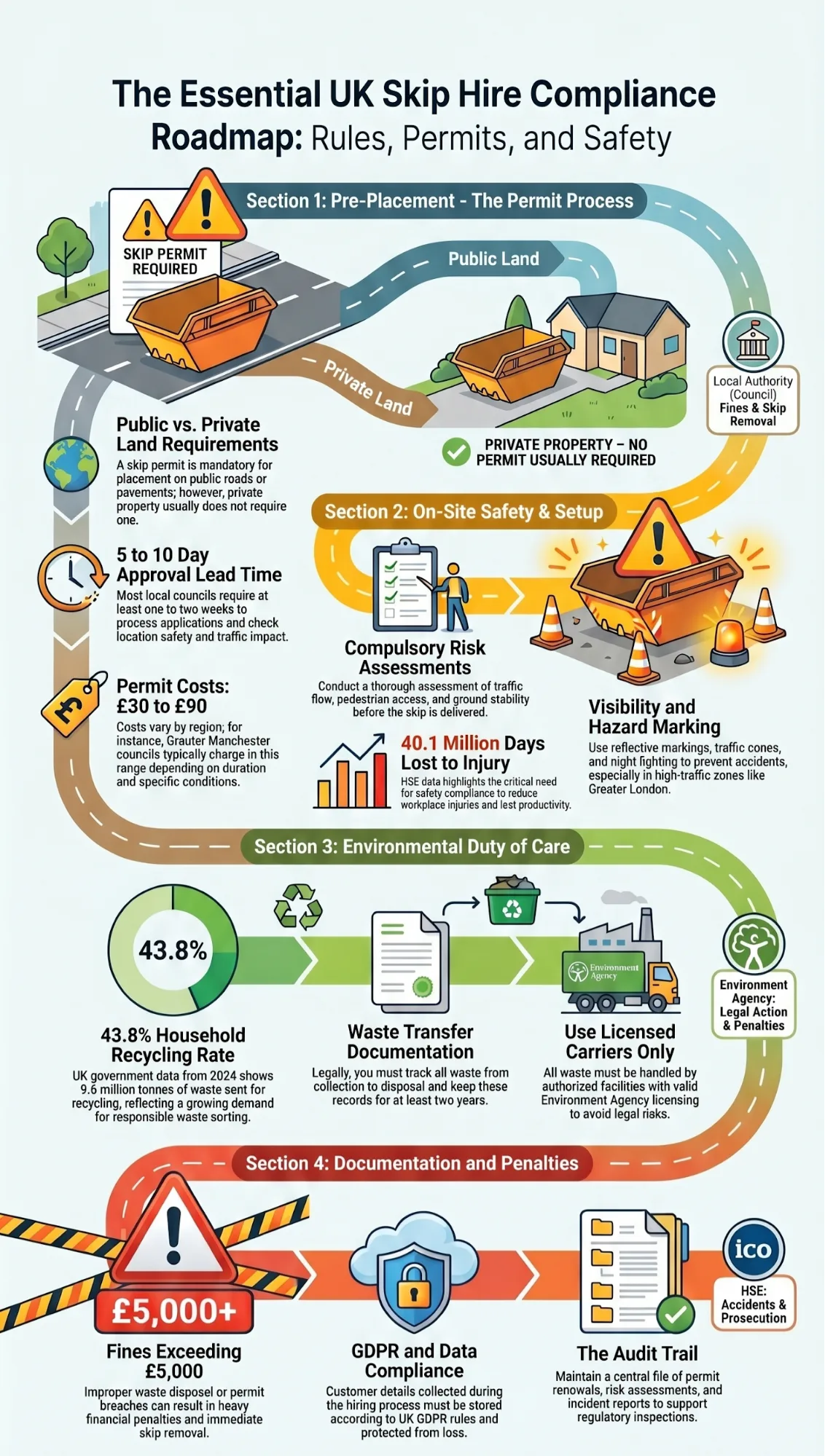
A skip permit is required when we place a skip on public land, such as a road or pavement, and it must be approved by the local authority. Private land usually does not require a permit.
In areas like Greater London, councils often have stricter permit conditions due to traffic and space limits. These can include lighting, cones, and specific placement rules.
Permit applications involve an approval process that checks location safety, traffic impact, and duration. Most councils process applications within 5 to 10 working days.
Permit costs vary by region. For example, councils in Greater Manchester may charge between £30 and £90 per permit, depending on duration and conditions.
We must follow all permit conditions once approved. This includes keeping the skip visible, properly marked, and placed in the agreed position.
Before applying, we need to understand what councils expect from us during the permit application process.
This list outlines the standard steps we follow to secure legal authorisation for a skip placement on public land.
Submit a permit application to the local council
Provide location details and duration
Confirm safety measures such as lights and markings
Wait for approval before placing the skip
Follow renewal requirements if the permit expires
Once approved, we move into operational compliance, where safety and environmental rules apply.
Environmental Permits and Waste Compliance
Environmental compliance requires us to handle waste responsibly under UK law, including sorting, transport, and disposal rules set by the Environment Agency.
This reduces environmental harm and legal risk. Waste must be taken to authorised facilities with proper licensing.
Data from the UK Government demonstrates
"The official England waste from households recycling rate was 43.8% in 2024, with a total of 9.6 million tonnes of waste sent for recycling, an increase of 0.6% on the previous year.” – GOV.UK
We must also follow duty of care requirements. This means we track waste from collection to disposal using documentation such as waste transfer notes.
In counties like Kent, stricter checks may apply to construction waste, especially when dealing with hazardous materials. This increases the importance of correct classification and handling.
Environmental permits may be required for certain waste activities, especially for large-scale or commercial projects. These permits outline what waste can be handled and how.
To stay compliant, we follow structured environmental rules that guide how we manage waste from start to finish.
Below are the main compliance obligations we follow to meet environmental standards and avoid penalties.
Use licensed waste carriers and disposal sites
Keep waste transfer notes for at least two years
Separate recyclable and hazardous materials
Follow Environment Agency guidance
Report incidents or spills when required
These steps support legal compliance and reduce the risk of enforcement action.
Health and Safety Compliance on Site

Health and safety compliance ensures we protect workers, the public, and property when using skips. It follows the Health and Safety at Work Act 1974 and related regulations.
We must carry out risk assessments before placing a skip. This helps identify hazards such as traffic flow, pedestrian access, and uneven ground.
In areas like the West Midlands, councils often require reflective markings and night lighting to reduce accidents in busy zones.
Workplace safety rules also apply when loading skips. Overfilling or unsafe loading can lead to fines and safety risks during transport.
Insights from the Health and Safety Executive (HSE) indicate
“40.1 million working days lost due to work-related illness and workplace injury.” – HSE
We must also train staff and follow clear procedures to manage risks during operations.
Before listing key requirements, we highlight how safety rules support both legal compliance and practical risk management on every project.
These are the main safety measures we apply when placing and using skips in public or shared spaces.
Use cones, lights, and markings for visibility
Avoid overfilling beyond legal limits
Keep access clear for pedestrians and vehicles
Conduct risk assessments before placement
Follow incident reporting procedures
These steps reduce accidents and support compliance with UK safety law.
Data Protection and Record Keeping
Data protection compliance applies when we collect and store customer details during skip hire services. It must follow GDPR rules and UK data protection law.
We must have a lawful basis for processing personal data, such as contract necessity or legal obligation. This ensures we handle information legally and transparently.
Record keeping also plays a key role in compliance management. We must maintain an audit trail of permits, waste transfers, and safety checks.
According to the Information Commissioner’s Office, organisations must store only necessary data and protect it from misuse or loss.
Documentation supports compliance audits and due diligence. It shows that we meet legal standards and follow regulatory requirements.
Before listing the key documentation we manage, we explain why accurate records reduce legal risk and improve operational control.
These are the core records we maintain to meet compliance obligations and support inspections or audits.
Permit approvals and renewal records
Waste transfer notes and disposal logs
Risk assessments and safety checks
Customer data with GDPR compliance
Incident and inspection reports
Strong record keeping supports regulatory oversight and helps avoid penalties.
Compliance Framework and Risk Management
A compliance framework helps us organise legal requirements, monitor performance, and manage risk across all operations. It ensures we meet regulatory standards consistently.
This framework includes internal controls, compliance monitoring, and regular reviews. It supports corporate governance and reduces legal risk.
We also rely on compliance officers or legal counsel to guide decisions and interpret regulations. This helps us respond to changes in UK law.
Risk management is part of this framework. It involves identifying potential issues, such as permit delays or safety risks, and planning how to address them.
A structured compliance strategy helps us operate smoothly across different regions and regulatory conditions.
Before outlining the framework elements, we explain how a clear system improves efficiency and supports lawful operations at every stage.
These are the main components of our compliance framework used in skip hire and waste management.
Compliance checklist for permits and legal duties
Internal controls for monitoring operations
Regular compliance audits and reviews
Risk assessment and incident tracking
Ongoing staff training and updates
This structure supports operational compliance and reduces the chance of enforcement action.
Regulatory Oversight, Inspections, and Penalties
Regulatory bodies oversee compliance and enforce legal rules through inspections, audits, and penalties. This includes local councils and the Environment Agency.
Inspections may check permit conditions, waste handling, and safety measures. These can happen during or after a project.
Failure to comply can lead to fines, sanctions, or legal action. For example, improper waste disposal can result in penalties exceeding £5,000 under UK law.
In some cases, operating without a permit may lead to immediate removal of the skip and additional charges from the council.
Regulatory oversight ensures that all operators follow the same legal standards and protect public safety.
Before listing enforcement risks, we highlight how compliance reduces disruption and protects both our operations and customers.
These are the main consequences we avoid by meeting legal requirements and maintaining strong compliance practices.
Fines for permit breaches or illegal placement
Penalties for improper waste disposal
Enforcement action from local authorities
Project delays due to non-compliance
Legal risk affecting business operations
Staying compliant protects our work and avoids unnecessary costs or delays.
Comparison of Key Compliance Areas
We can better understand compliance by comparing the main areas and what each one requires in practice.
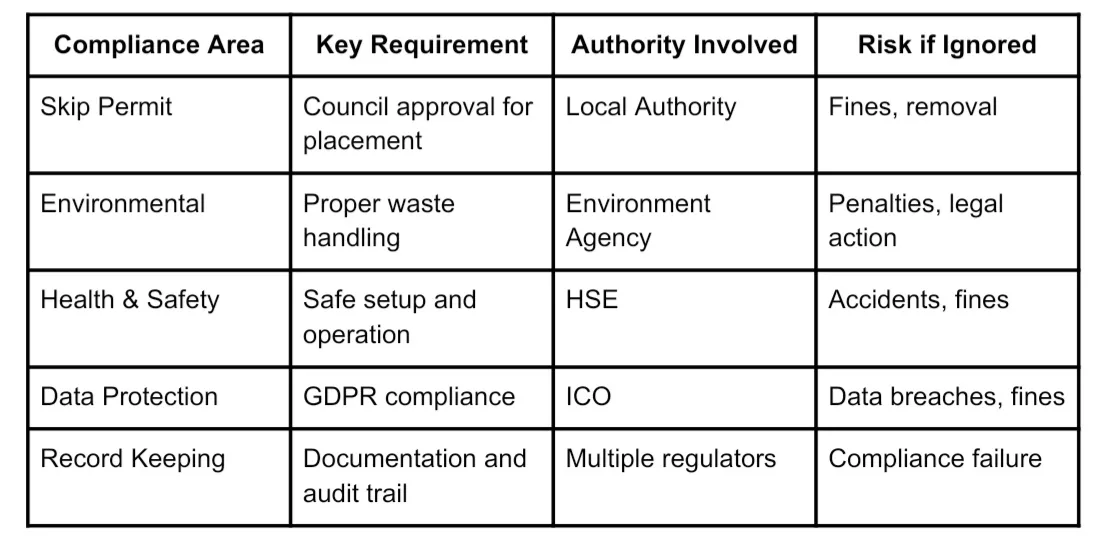
This table helps us see how each area fits into the wider compliance framework.
External Guidance and Legal Standards
We rely on trusted sources to guide our compliance practices and confirm legal standards across operations.
According to Gov.uk, skip permits are required when placing skips on public highways, and councils set specific conditions for safety and duration.
The Environment Agency explains that waste duty of care applies to all businesses handling waste, requiring proper documentation and authorised disposal.
These sources provide clear guidance that supports our compliance strategy and ensures we follow UK law correctly.
FAQ
We only need a permit if the skip is placed on public land such as a road or pavement. If we place it on private property like a driveway, a permit is usually not required.
Most local authorities process permit applications within 5 to 10 working days. In busy areas like Greater London, it may take longer due to higher demand and stricter checks.
Placing a skip without a valid permit can lead to fines, removal by the council, and additional charges. This is considered a breach of local authority regulations.
We must keep records such as permit approvals, waste transfer notes, and risk assessments. These documents support compliance audits and show we meet legal obligations.
Yes, rules can vary by council. In areas like Kent or the West Midlands, permit conditions, costs, and safety requirements may differ, but the core UK legal framework remains the same.
Legal Rules, Permits & Compliance in Skip Hire
Legal rules, permits, and compliance shape how we manage skip hire safely, legally, and efficiently across the UK. They guide every step from application to waste disposal.
We follow clear permit requirements, meet environmental standards, and maintain safety across all projects. This reduces risk and supports smooth operations in different regions.
Whether we operate in Greater London, Greater Manchester, or other parts of the UK, local rules may vary, but the core compliance framework remains consistent.
We keep records, follow permit conditions, and monitor compliance to avoid penalties and delays. This helps us stay aligned with UK law and regulatory expectations.
For straightforward, compliant skip hire across the UK, we provide clear guidance and support every step of the process. Visit Skip Hire to get started today.
References
Related Articles
Filed under:
Skip Permits