
Estimating your waste volume accurately means you're less likely to book the wrong skip size. It involves simple measurement, converting that to a useful unit like cubic yards, and then adjusting for what you're actually throwing away.
Doing this stops you from hiring a skip that's too small or paying for one that's half empty. It makes planning easier and helps keep your project on budget.
To learn a straightforward method, keep reading.
Skip Size Estimation: Get It Right First Time
These key points show how to accurately estimate your waste so you choose the right skip and avoid extra costs or delays.
Use simple measurements (Length x Width x Height) and everyday references like bin bags to start your estimate.
Always adjust your volume estimate based on the type of waste, as heavy materials like soil weigh much more per cubic metre.
Add a buffer of 10-15% to your final calculation to account for irregular shapes and air gaps in the waste pile.
Introduction to Accurate Waste Volume Estimation

Waste volume estimation is about figuring out how much space your rubbish will take up. It's not a guess.
It involves measuring your pile, converting that to cubic yards or metres, and understanding how different materials, like soil versus cardboard, behave.
The aim is to match your waste to the correct skip size, which saves you money and stops project delays, especially when using reliable skip sizes waste estimation methods.
Getting it wrong costs real money. Industry guidance shows poor planning can add twenty to thirty percent to disposal costs from extra hires or overweight fees.
For a household, that's an unexpected bill. Accurate estimation also helps with planning and rules. It lets you book the right skip for the right time and avoid overfilling, which is a safety issue.
In places like Greater London, council permits for road skips often have size limits, so a good estimate helps you stay within them.
Waste Volume Estimation Fundamentals Explained
Waste volume is the space your rubbish takes up, measured in cubic metres (m³) or cubic yards (yd³) in the UK. It's important to remember this is different from weight.
A skip has two separate limits: one for how full it can be (volume) and one for how heavy it can be (weight), making it essential to understand weight limits and overloading when planning your hire.
A few key things change how waste fills that space:
Waste type. Light, bulky items like cardboard and furniture take up a lot of room but aren't heavy. Dense, heavy materials like soil, concrete, and rubble weigh much more for the same amount of space.
Compaction and air gaps. Loose waste, like garden clippings, has lots of air pockets and can be squashed down. Solid rubble has fewer gaps. How the material sits in the skip affects your final volume.
Volume Calculations Using Measurement Techniques

For a more accurate estimate, you can measure your waste pile directly. This is a hands-on method. You'll need a tape measure. Measure the length, width, and average height of your pile in metres. Then, multiply those three numbers together. The result is the volume in cubic metres.
The formula is simple: Length (m) x Width (m) x Height (m) = Volume (m³). This basic calculation gives you a much better figure than a guess. It turns a messy pile into a shape you can work with.
Since UK skip sizes are listed in cubic yards, you'll often need to convert. One cubic metre is roughly 1.31 cubic yards. So, if you calculate 4 cubic metres, that's about 5.24 cubic yards. This helps you see which standard skip size, like a 6-yard or 8-yard model, you'll need.
In a recent analysis by Belfast City Council
"The basic method is quite straightforward: i. Estimate the total weekly waste arising from the development ii. Estimate how the weekly waste arisings break down (in proportions or percentages) into various individual waste streams... Estimating the volume of waste which will arise from the development is a fundamental building block of the process." - Belfast City Council
Converting Everyday Waste Into Measurable Units
The trick is to translate your real-world pile of waste into a measurable unit. You might have old furniture, garden soil, and bags of rubbish. You need to convert each part into a volume. Using everyday references makes this manageable.
For bagged waste, just count your standard black bin bags. A good rule is that ten bags equals roughly 0.2 to 0.3 cubic metres.
For larger items, think about common spaces: could that timber fit in a car boot? Would the soil fill a small trailer? This kind of visualisation helps bridge the gap between what you see and the numbers you need.
Here’s a quick reference table to help:

These figures provide a solid starting point. You build your total estimate by adding up these unit counts, which is a simple but effective system.
Adjusting Estimates Based on Waste Type and Density
Your calculated volume is a starting point, not the final answer. You have to adjust it based on what you're throwing away. Heavy materials are dense, which means they'll hit a skip's weight limit long before the container looks full. For heavy waste, the usable volume is actually less.
Take soil, for example. It can weigh over a tonne per cubic metre. If you have 3 cubic metres of soil, that's over 3 tonnes. A standard 4-yard skip might only have a 4-tonne weight limit, so you could only put about 3.5 cubic metres in before you hit the limit, even though the skip holds more space.
It helps to categorise your waste:
Light waste: cardboard, packaging.
Medium waste: garden vegetation.
Heavy waste: rubble, concrete, soil.
For projects with heavy waste, you should consider booking a smaller skip than your volume suggests, or be ready for it to look only partly full. This is a common point that waste transfer stations often mention.
Data from HESA demonstrates
"To convert from volume data to mass equivalent, the following guide and high level factor are recommended: volume (in m3) x factor = mass (tonnes)... 'Pay by weight' or survey based estimates can be used to improve the accuracy of data." - HESA
Hard vs Soft Waste Measurement Methods
There are two main ways to estimate waste volume: hard and soft methods.
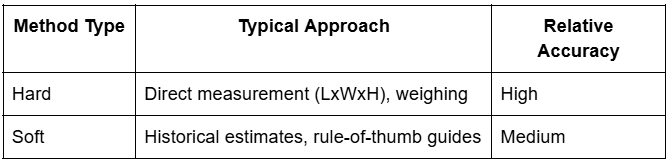
Hard methods use direct measurement and data. This includes the length x width x height calculation, physically weighing waste, or using audit kits. These aim for high accuracy.
Soft methods rely on estimates and rules of thumb. You might use a guideline like "a kitchen refit produces about 4 cubic metres of waste" or base it on a past project. These are quicker but less precise, useful for initial planning.
The method you choose depends on your goal. For a precise skip hire booking, hard methods are better.
For general planning, a soft method might be enough. In practice, we recommend starting with a soft method to get a rough idea, then using a hard method for your final decision.
Here’s a quick comparison:
Using Waste Data and Analytics for Accurate Tracking

Here are the key points on using data to improve waste estimates.
Build a historical record. For larger or repeated projects, track what you actually dispose of. Conduct a simple waste audit, recording types and volumes, or note collection weights. This data becomes your reference for future jobs.
Analyze for patterns. Look at your records to spot trends. You might learn that a garden clearance always yields about 2 cubic metres of soil, or a standard room clearance produces 1.5 cubic metres of mixed waste. This turns estimation from a guess into a reliable forecast.
Use digital tools. Online waste volume calculators can help. They often use these data principles, asking for waste type and rough dimensions to recommend a skip size.
Combining these tools with your own records leads to more accurate planning, which is valuable for budgeting and sustainability reporting.
Common Waste Estimation Mistakes and How to Avoid Them
Here are the common mistakes that lead to poor waste estimates.
Ignoring density and weight limits. People often calculate a volume, like 6 cubic metres for soil, and book a 6-yard skip. The soil hits the skip's weight limit long before it's full, leading to an overweight charge or a refused collection.
Underestimating irregular shapes. Measuring a neat pile on the ground doesn't account for how waste spreads out when loaded. This leads to an undercount. Not adding a buffer for air gaps and compaction also means the skip fills faster than you planned.
Relying on guesswork. Skipping simple measurement and just "eyeballing" the pile is a common cause of problems. Industry feedback suggests overfilled skips, often from these errors, lead to extra fees or rejections in a notable number of domestic hires.
Practical Step-by-Step Waste Volume Estimation Routine

Follow this simple routine for a reliable skip size estimate.
Step 1: Identify your waste type. Is it mostly light (cardboard), heavy (soil), or mixed? This sets your basic approach.
Step 2: Measure or estimate the volume. For a pile, use length x width x height. For scattered items, use bin bags or car boot counts. Convert everything to cubic metres.
Step 3: Convert to cubic yards. Multiply your cubic metre total by 1.31 to get the volume in skip-relevant units.
Step 4: Adjust for weight if needed. If your waste is heavy like soil or rubble, remember you might hit the weight limit before the skip is full. Your usable volume could be lower, so consider a smaller skip.
Step 5: Add a buffer and match to a size. Add 10-15% to your final figure to account for air gaps, then match that adjusted volume to a standard skip size suitable for UK households skip size needs.
FAQ
You can estimate Waste Volume by separating waste types such as food waste, recyclable materials, and hazardous waste. Start with basic waste estimation by counting bins, then apply volumetric calculations to improve accuracy. Combine waste data with waste generation rates to measure total waste output. This approach supports better waste management and follows a clear waste measurement methodology.
You can use a waste calculator, waste audit kits, and digital tools to improve accuracy. Hard measurement techniques such as Weight Volume Analysis and Volumetric Waste Measurement provide precise results. Soft measurement approaches, such as per capita generation rates, help when direct data is limited. Combining both methods improves waste metrics and strengthens data collection for reliable reporting.
Businesses track waste output by collecting primary data from daily operations and analyzing waste generation patterns over time. Methods such as Material Flow Analysis and Load Count Analysis help identify waste factors and inefficiencies. Collection Time Tracking and data from truck teams also improve accuracy. This process supports ESG reporting and improves waste planning decisions.
Accurate waste estimation helps meet regulatory requirements and environmental standards while improving landfill diversion rate and recycling rates. It supports sustainability teams in tracking waste metrics and energy recovery efforts. Clear waste data also aligns with frameworks such as the International Performance Measurement and Verification Protocol, which helps organizations demonstrate responsible solid waste management.
A small business can estimate waste by tracking bin usage, dumpster size, and skip bags over time. Using a waste volume calculator and simple volumetric calculations improves accuracy. Working with a licensed waste carrier and a Waste Transfer Station also helps manage waste disposal. These steps create reliable waste data without requiring complex systems or high costs.
Estimate Smart, Book with Confidence
Accurate waste estimation turns uncertainty into control. When you measure your pile, consider weight, and add a small buffer, you avoid overpaying or running short. These simple steps work anywhere, whether you are planning a project in Moray or Norfolk.
Guesswork leads to delays, extra costs, and frustration. A clear estimate keeps your project efficient and stress free from the start.
Start your Search Skip Hire to compare verified local providers and book the right skip with confidence.
References
https://www.belfastcity.gov.uk/Documents/Waste-Storage-Guidelines/Commercial-developments-in-Belfast
Related Articles
Filed under:
Skip Sizes