
Skip weight limits are the maximum safe weight a skip and the vehicle carrying it can handle. They are set for safety and legal reasons.
Overloading a skip means exceeding this weight limit or filling it above its top rails. This creates serious risks, including fines, vehicle damage, and dangerous accidents.
Many people get caught out by weight limits. They fill a skip until it looks full, not realizing that heavy materials like soil or rubble can make it overweight long before it reaches the top. This leads to refused collections, unexpected charges, and project delays.
To learn exactly how weight limits are set and how to stay on the right side of them, keep reading.
Skip Weight Rules: Stay Safe, Avoid Fines
These key points show how understanding weight limits helps you load your skip safely, legally, and without costly issues.
Skip weight limits are strict safety and legal rules, not just suggestions. Overloading can lead to fines, penalty points, and refused collections.
Overloading happens in two ways: exceeding the maximum weight limit or filling waste above the skip's top rails, both of which are equally problematic.
Preventing overloading requires understanding the weight of your waste materials and choosing the correct skip size for your specific job.
How Skip and Vehicle Weight Limits Are Calculated
Weight limits are not random numbers. They are carefully calculated based on the design of the skip and the lorry that carries it. Every vehicle has a legal maximum weight it is allowed to carry on the road, known as its Gross Vehicle Weight (GVW).
The limit considers the vehicle's axles, suspension, brakes, and the strength of the skip itself. Skip hire companies then set a safe working weight for each skip size they offer.
This ensures that when the loaded skip is lifted onto the lorry, the total weight does not exceed the vehicle's legal and safe capacity.
The type of waste is a critical factor. A cubic yard of heavy material like soil or concrete weighs much more than a cubic yard of light garden waste or cardboard, which is why understanding skip sizes in cubic yards helps put volume and weight into better context.
Therefore, a skip might reach its weight limit when it is only half full of rubble, but could be filled to the brim with light packaging. Companies provide estimated weight ranges based on typical waste types.
What Counts as Overloading in Real-World Scenarios
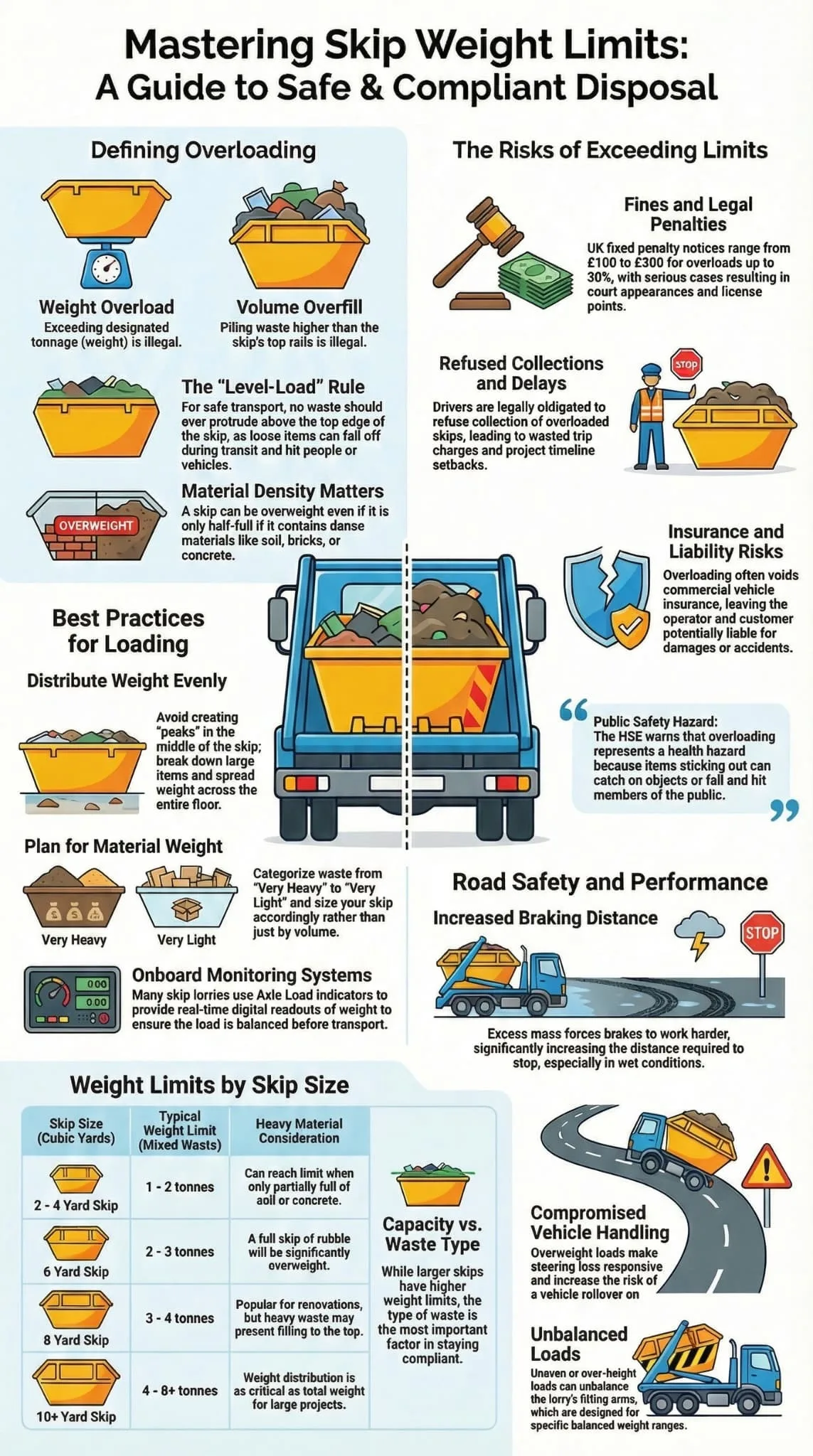
Overloading is not just about the number on a scale. Skip hire companies and drivers look for two clear signs.
The two types of overloading
Weight overload. This means the total weight of the skip and its contents exceeds the agreed or safe limit. Even if the skip looks only partially full, it can be overweight if it contains dense materials like soil or concrete.
Volume overfill. This is when waste is piled higher than the top edge of the skip. The rule is simple: no waste should be above the top rails. A skip must be "level-loaded" for safe transport, as loose items can fall off during transit.
Insights from Health and Safety Executive (HSE .gov.uk) indicate
"Container skips can be filled with a variety of materials resulting in a wide range of load weights. The operator should therefore be able to assess the weight using a range of indicators. [...] Overloading a skip represents a potential health hazard to both the driver taking it away and members of the general public. When a skip is transported, anything sticking out could catch on something or even fall out and hit someone. It is also illegal to overfill a skip." - Health and Safety Executive
Both types are taken seriously. A driver is legally entitled and obligated to refuse collection if a skip is overloaded by weight or volume, for their safety and the safety of the public.
It does not matter if you are in Greater London or Greater Manchester; the same rules apply across the UK to ensure consistent safety standards.
A Guide to Typical Skip Weight Limits
To help you plan, here is a general guide to the approximate weight limits for common skip sizes. Remember, these are estimates, and the exact limit will always be set by your specific hire company.
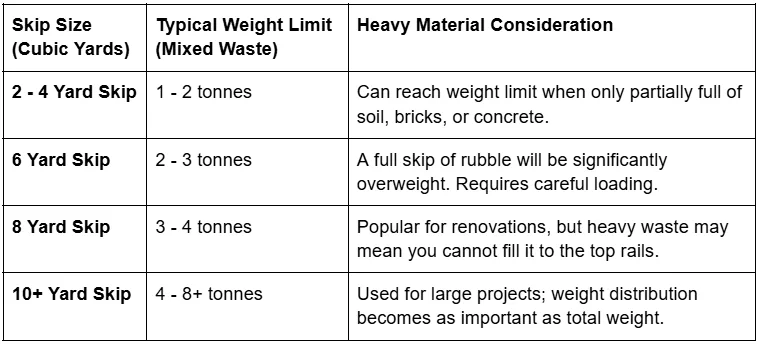
This table shows a key point: the larger the skip, the higher the weight limit, but the type of waste you have is the most important factor. Always confirm the exact limit with your provider when you book.
The Legal Risks of Overloading a Skip
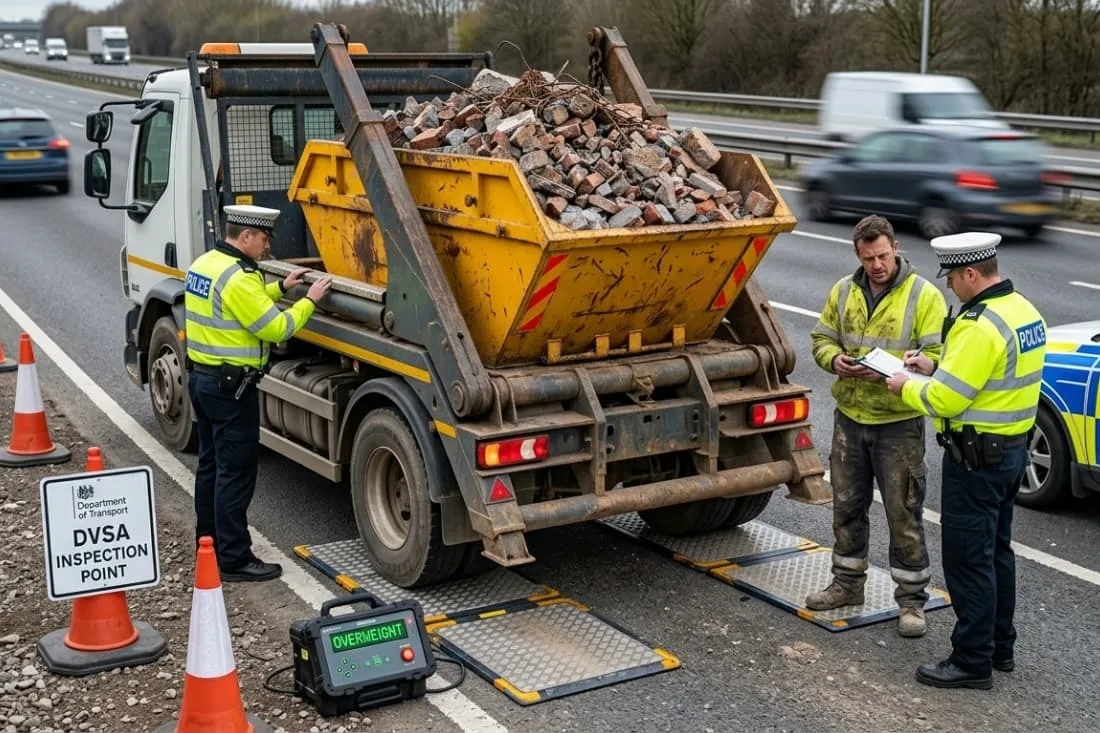
Overloading a skip is not just a breach of your hire agreement; it can be a legal offence. In the UK, the Road Traffic Act governs vehicle weights on public roads. The Driver and Vehicle Standards Agency (DVSA) can stop and weigh commercial vehicles, including skip lorries, at any time.
If a skip lorry is found to be overloaded, the consequences fall on the operator. However, these costs and penalties are often passed back to the customer who caused the overload.
Penalties can start with a fixed penalty notice, which can be £100 to £300 for being up to 30% over the weight limit. For more serious overloads, the case can go to court, leading to larger fines and penalty points on the driver's license.
In severe cases, the DVSA can issue a prohibition notice, meaning the vehicle cannot be driven until the overload is corrected. This causes immediate delays.
For the customer, the direct legal risk is usually financial, but it can also involve being liable for any accidents or damage caused by an overloaded skip.
As highlighted by Health and Safety Authority (HSA)
"It is against the law for a skip lorry to be overloaded or for material from a vehicle or skip to fall out onto the public road. All loads that are carried by vehicles, including skips and their contents, must be properly secured to the vehicle at all times. Skips must be covered so that material inside does not fall out onto the road, or onto people or vehicles, while being lifted on or off the vehicle or transported." - Health and Safety Authority
How Overloading Affects Safety and Vehicle Performance

The safety risks of overloading are significant and tangible. An overloaded vehicle behaves very differently on the road.
Key safety risks of an overloaded skip
Increased braking distance. The brakes have to work harder to stop more mass, which is a major accident risk, especially in wet conditions.
Compromised vehicle handling. Steering becomes less responsive, and the risk of a rollover increases on corners or slopes. The extra weight puts immense strain on the vehicle's suspension, axles, and tyres.
Unbalanced or shifting load. An uneven or over-height load can shift during lifting or travel. This can unbalance the lorry or cause debris to spill onto the road. The lifting arms are designed for a balanced load within a specific weight range.
These are the real-world reasons why drivers will not collect an overloaded skip.
The Financial and Operational Consequences
Beyond safety and legal issues, overloading hits your project in practical and financial ways. The most immediate consequence is a refused collection.
The driver will not take the skip, leaving you with an overloaded skip on your property and a delayed project, which is exactly what tends to happen when a skip is overfilled beyond safe limits.
Fixing an overload usually involves extra cost and work. You may need to hire a second, smaller skip to offload the excess waste, or manually remove and sort waste to reduce the weight.
The skip hire company will likely charge for the wasted collection attempt and for the second trip to collect the now-corrected skip.
There are also hidden costs. An overloaded lorry uses significantly more fuel and causes more wear and tear on the vehicle, leading to higher operational costs. These factors all underline why getting it right the first time is the most efficient and cost-effective approach.
Why Insurance and Compliance Risks Matter
Overloading can create serious liability issues. Most commercial vehicle insurance policies are void if the vehicle is overloaded.
If an overloaded skip lorry is involved in an accident, the insurance company may refuse to pay for damages. This leaves the operator, and potentially the customer, liable for huge costs.
For businesses hiring skips, there are compliance risks under regulations like the Health and Safety at Work Act.
If you are a contractor and your overloaded skip causes an incident, you could be held responsible. This can lead to legal claims, investigations, and significant damage to your professional reputation.
Ensuring your skip hire is compliant is part of responsible project management. It protects you, the workers on your site, and the public.
Whether you are working on a domestic renovation in Powys or a commercial site in East Ayrshire, adhering to weight limits is a fundamental part of safe and professional operation.
How to Prevent Overloading: Practical Best Practices
Preventing overloading is straightforward with careful planning. The first step is communication. When you book a skip, describe your project and the main types of waste you will have.
A reputable company will then recommend the most appropriate skip size and explain its weight limit. Always check the confirmation for the stated weight allowance.
Understand the density of your waste. As a rough guide:
Very heavy: Soil, sand, and rubble.
Heavy: Mixed building waste.
Light: Garden waste, wood, and general household items.
Very light: Cardboard and packaging.
If your project involves heavy materials, you will likely need a larger skip than the volume suggests, simply to stay under the weight limit, especially when planning your skip sizes waste estimation for mixed or dense loads. It is better to hire a slightly larger skip than to overload a smaller one.
When loading, distribute weight evenly and never fill above the top rails. Break down large items and avoid creating a peak in the middle.
If you are unsure, it is always safer to leave a little space. Doing a daily check on the fill level as you work can help you stay on track.
Tools and Systems for Monitoring Weight

The transport industry uses various tools to manage weight limits effectively. Many modern skip lorries are fitted with onboard weighing systems.
These Axle Load Indicators give the driver a digital readout of the weight on each axle in real-time, helping them ensure the load is balanced and within limits before they set off.
For larger sites or frequent waste generation, portable weigh pads can be used. These are placed under the skip's wheels to get an accurate weight measurement on-site.
While these are more common for operators, as a customer, you can ask your hire company about their processes. A company that proactively manages weight compliance is likely to be reliable and safety-conscious. It shows they are serious about adhering to regulations, which benefits everyone.
FAQ
Exceeding a weight limit exposes you to Vehicle Overloading offences and legal action under the Road Traffic Act 1988. You may receive a fixed penalty, penalty points, or a court summons. It can also invalidate your insurance policy and insurance cover. Overloading increases accident risks, reduces road safety, and leads to higher maintenance costs and vehicle damage.
You can check vehicle weight limits on the chassis plate or vehicle identification plate, also known as the VIN plate. This plate shows the Maximum Authorized Mass, Gross Van Weight, and axle weight limits. The car owner’s manual also explains payload allowance and towing capacities. Always confirm gross vehicle weight before loading any cargo.
Proper load distribution keeps the centre of gravity stable and improves vehicle handling. Poor weight distribution increases braking distances, stopping distance, and rollover risk. It can also cause axle overloading and damage mechanical components, including the suspension system. Safe loading checks reduce accident risks and support better road safety during every journey.
Penalties for an overloaded van or Heavy Goods Vehicles can include Fixed Penalty Notices, penalty points, and a prohibition notice issued by the Driver and Vehicle Standards Agency. Serious Overloading offences may result in license suspension or further legal recourse. Transport operators may also face reputational damage and risks to their Operator License.
You can prevent overloading by following safe loading checks and completing daily vehicle checks before driving. Use weighing scales or Portable Weighpads to confirm cargo weight and vehicle loads. Monitor axle weighing solutions and payload allowance carefully. Good Safety Practices improve fuel economy, reduce carbon emissions, and keep your vehicle within legal weight limits.
Stay Within Limits, Keep Your Project Moving
Weight limits are not just guidelines, they protect your safety, your budget, and your timeline. Understanding how volume and waste type affect weight helps you avoid overloading, fines, and costly delays.
Ignoring limits can stop your project in its tracks. But planning with both size and weight in mind keeps everything compliant and efficient from start to finish.
Start your Search Skip Hire to connect with verified local providers who can guide you safely and confidently.
References
Related Articles
Filed under:
Skip Sizes