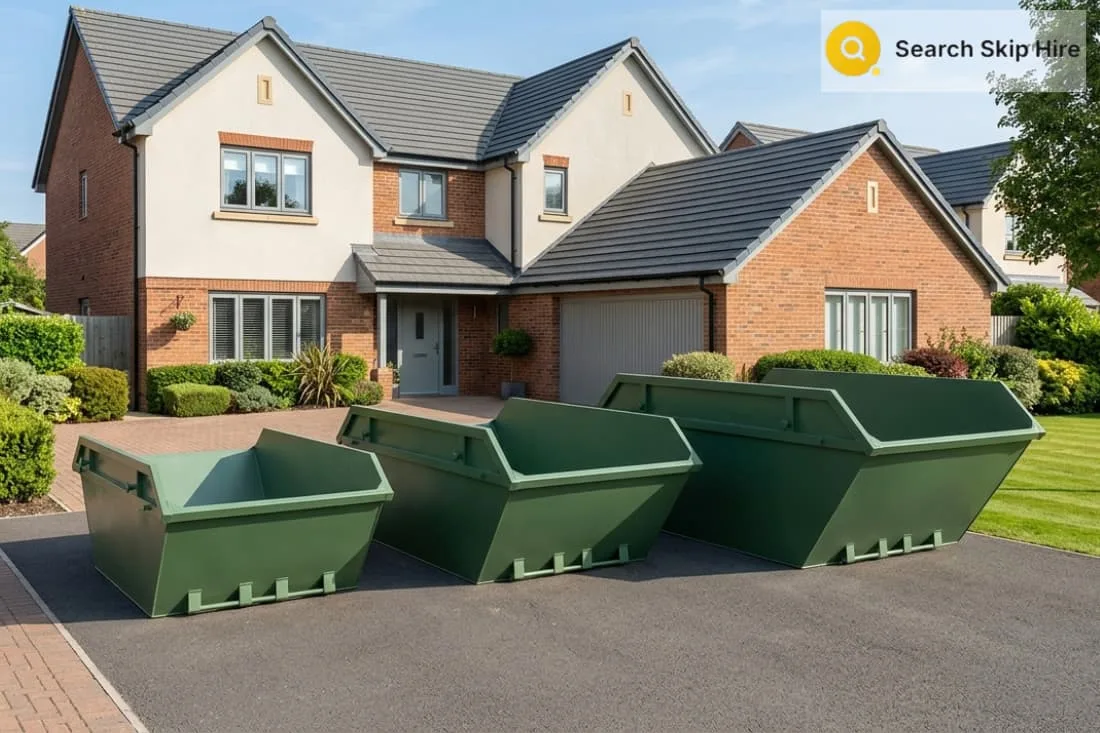
Skip sizes in cubic yards measure the volume of waste a skip can hold. A cubic yard is a standard unit, telling you how much space your rubbish will take up, not its weight. Choosing the right size helps you avoid paying for unused space or needing a second skip.
Many people struggle to visualise how much waste will fit. Ordering a skip that's too small causes extra hassle and cost, while one that's too large wastes money and space.
Keep reading to learn how to match common skip sizes to your specific job, whether you are in Greater London or Highland.
Skip Sizes Explained: Choosing with Confidence
These key points show how understanding volume, project needs, and local rules helps you pick the right skip without guesswork.
Skip sizes are measured in cubic yards, a unit of volume that helps you estimate how much waste a container can hold based on space, not weight.
Common sizes range from 2-yard mini skips for small DIY jobs to 12-yard and larger skips for major renovations and construction sites.
Choosing the correct size requires considering your project type, the materials you are disposing of, and any local permit requirements for skip placement.
What Does "Cubic Yards" Mean for Skip Sizes?
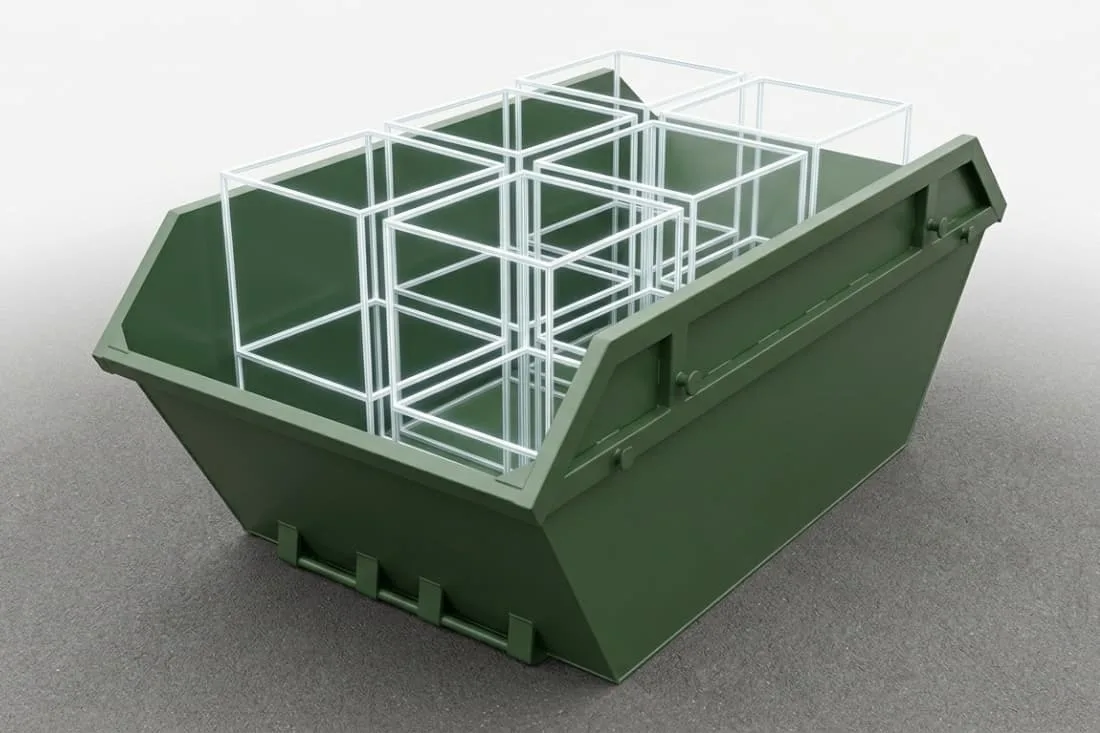
A cubic yard is a measurement of volume. It's the space inside a cube that's one yard long, one yard wide, and one yard high. For skip hire, this measurement tells you how much rubbish you can fit inside the container.
In the UK, the skip hire industry uses cubic yards as its primary unit for sizing. It's the common measurement for comparing quotes and options from different companies.
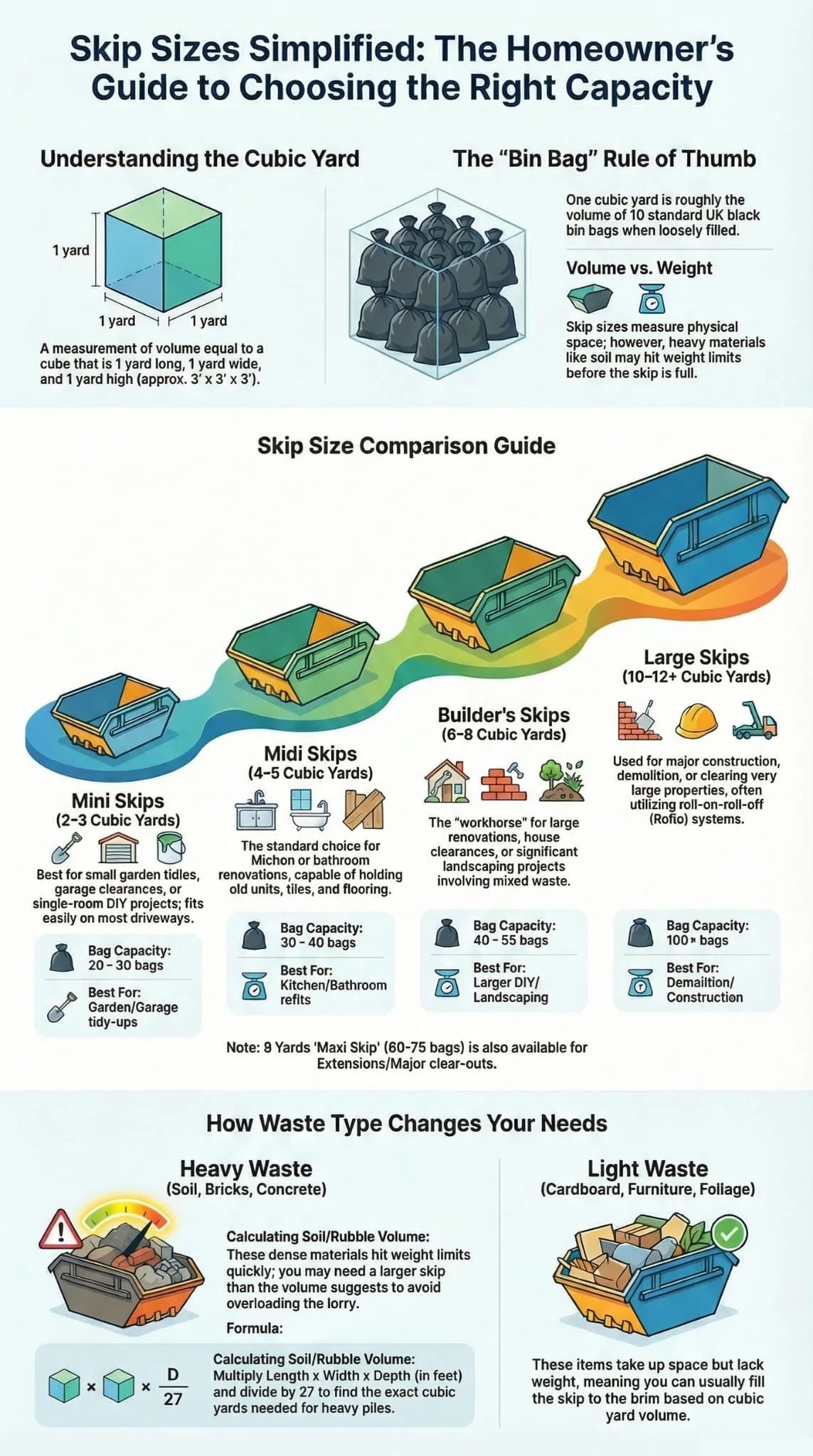
To help you picture it, one cubic yard is roughly the volume of about ten standard UK black bin bags when they are loosely filled. It's also about three-quarters of a cubic metre. You can think about how many bin bags your project will fill and convert that into the cubic yards you need.
As noted by City of Ontario, California
"The size of skip bins can vary greatly depending on their use, with sizes ranging from small 2 cu. yd. mini-skips to the very large 40 cu. yd. roll-on/roll-off skips. A 2 cu. yd. A miniature skip holds approximately 25-35 black bin bags and is an economical choice for small garden or household waste, while a 4 cu. yd. medium skip holds approximately 45-55 black bin bags." - City of Ontario, California
Why Skip Sizes Use Cubic Yards and Not Just Weight
Skip sizes use cubic yards because the physical space the waste occupies matters most for transport. A lorry can only carry a container of a certain size.
The weight of the waste is a separate, but also important, factor. Companies have weight limits for each skip size to protect their vehicles and comply with road safety laws.
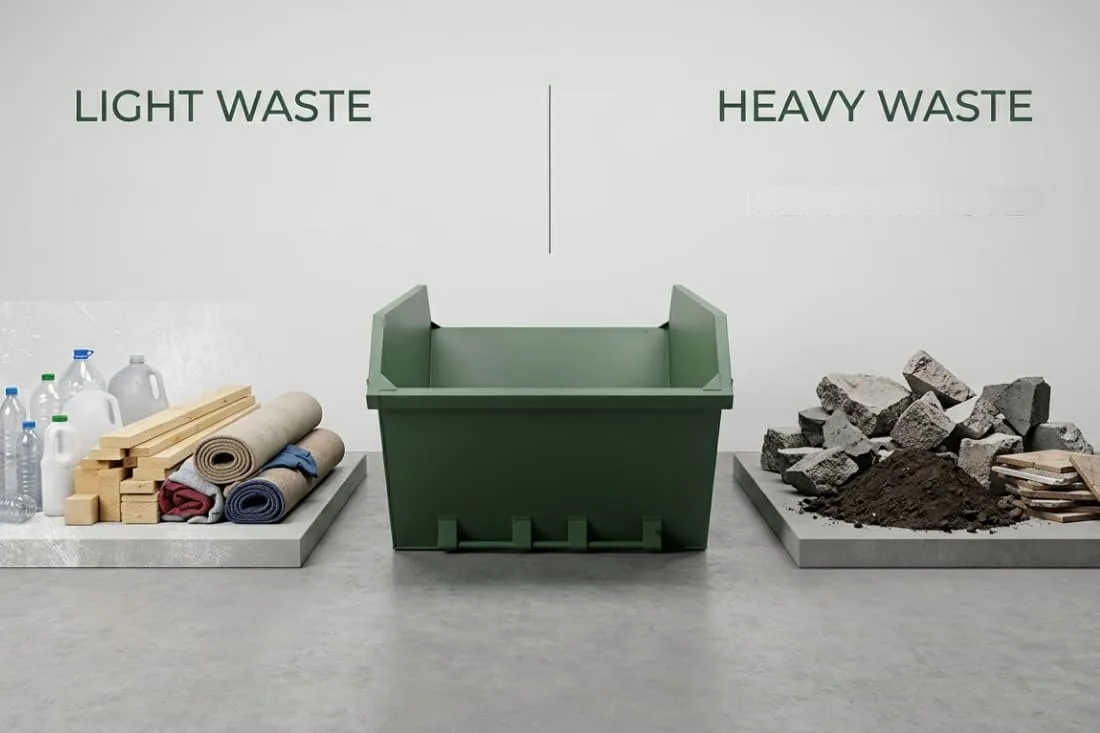
Different types of waste have very different weights for the same volume. A cubic yard of soil or rubble is very heavy and might reach the skip's weight limit before it looks full.
A cubic yard of light garden waste or cardboard is not very heavy, so you could fill the skip to the brim. This is why you see both volume and weight restrictions in hire terms.
This system protects everyone. It ensures the skip lorry is not overloaded, which is dangerous and illegal. It also means you pay a fair price based on the capacity you are using.
Research from Culver City / University of Arkansas Cooperative Extension shows
"The size of a bin or pile should be at least 1 cubic yard, which measures approximately 3' x 3' x 3'. For larger clean-up or construction projects, special 8 & 10 cubic yard 'lowboy' containers are specifically utilized for heavy materials such as dirt, concrete, or asphalt collection to ensure safe transport weights." - Culver City / University of Arkansas Cooperative Extension
Common Skip Sizes and Their Typical Uses
Skip hire companies offer a range of standard sizes measured in cubic yards. Each size is designed for a different scale of job, making it easier to compare options when looking at a skip size guide for different types of household projects.
Common skip sizes and their uses
Mini skips (2-3 cubic yards). Perfect for small domestic projects like clearing out a garage, a small garden tidy-up, or a single-room DIY project. They are compact enough to fit on most driveways.
Midi skips (4-5 cubic yards). A popular choice for home renovations like refitting a kitchen or bathroom. They can handle the waste from stripping out old units, tiles, and flooring.
Builder's skips (6-8 cubic yards). The workhorse for larger renovation projects, house clearances, or significant garden landscaping. An 8-yard skip provides substantial capacity for mixed building waste.
Large skips (10+ cubic yards). Used for major construction, demolition work, or clearing very large properties. These are often used in a roll-on-roll-off (RoRo) system for commercial and industrial sites.
A Guide to Matching Skip Size to Your Project
Choosing the right skip size is about matching the container's capacity to your job. Getting it wrong can be costly. A skip that's too small means you'll need a second collection. A skip that's too large wastes money and space.
How to choose the right size for your job
For very small projects: A 2 or 3-yard mini skip is ideal for a garden clear-out or cleaning out a small loft, cellar, or single room. In areas with narrow streets, a mini skip is often the only practical choice for on-street placement.
For a kitchen or bathroom renovation: A 4 or 5-yard midi skip is usually the best fit. It can handle old units, appliances, tiles, and plasterboard. If you're also replacing flooring, lean towards the 5-yard size to be safe.
For larger domestic projects: You'll likely need a 6 or 8-yard builder's skip. This includes jobs like a full house clearance, a large extension, stripping out multiple rooms, or removing a patio or significant soil.
How Different Types of Waste Affect Your Choice
The type of waste you're disposing of is just as important as the amount when choosing a skip size. You need to think about the nature of your rubbish to avoid problems.
How waste type affects your skip choice
Heavy waste (soil, bricks, concrete). These materials are dense. A skip can look half-full but be at its maximum weight.
You often cannot fill a skip to the top, so you might need a larger skip than you think just to stay under the weight limit, especially when planning skip sizes waste estimation for heavier materials.
Light waste (garden foliage, cardboard, furniture). These items take up a lot of space but don't weigh much. You can usually fill a skip to the brim. Your main concern is the cubic yard volume, so estimating how many bin bags you have is a reliable method.
Mixed waste (common in renovations). This includes a combination of rubble, timber, and plasterboard. Estimate the volume first. If you have a lot of heavy material, consider choosing a skip one size larger than your volume estimate suggests to avoid breaching the weight limit.
A Quick Reference Table for Common Skip Sizes
To help you visualize and compare the most popular skip sizes, here is a simple reference table. It shows the typical capacity, common names, and best uses for each size range.
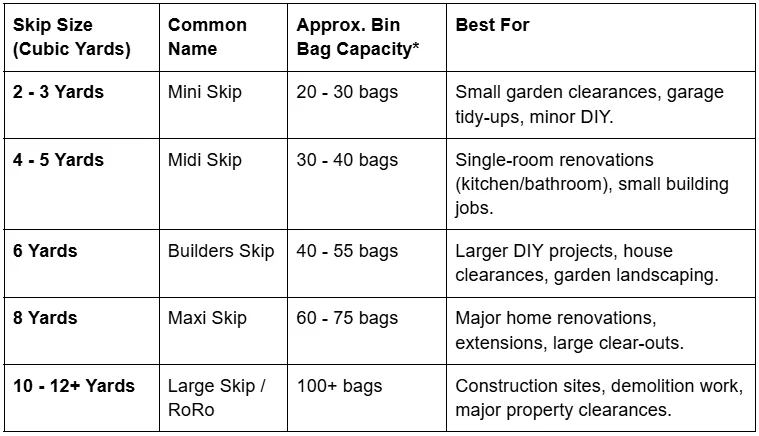
*Capacity is based on loosely filled standard UK black bin bags. Actual capacity can vary with waste type and how it is loaded.
The 6 to 8-yard skip is often the most popular for significant home improvement work. Remember, these are general guides, and your specific waste type will influence how much you can actually fit.
Estimating Your Waste Volume in Cubic Yards
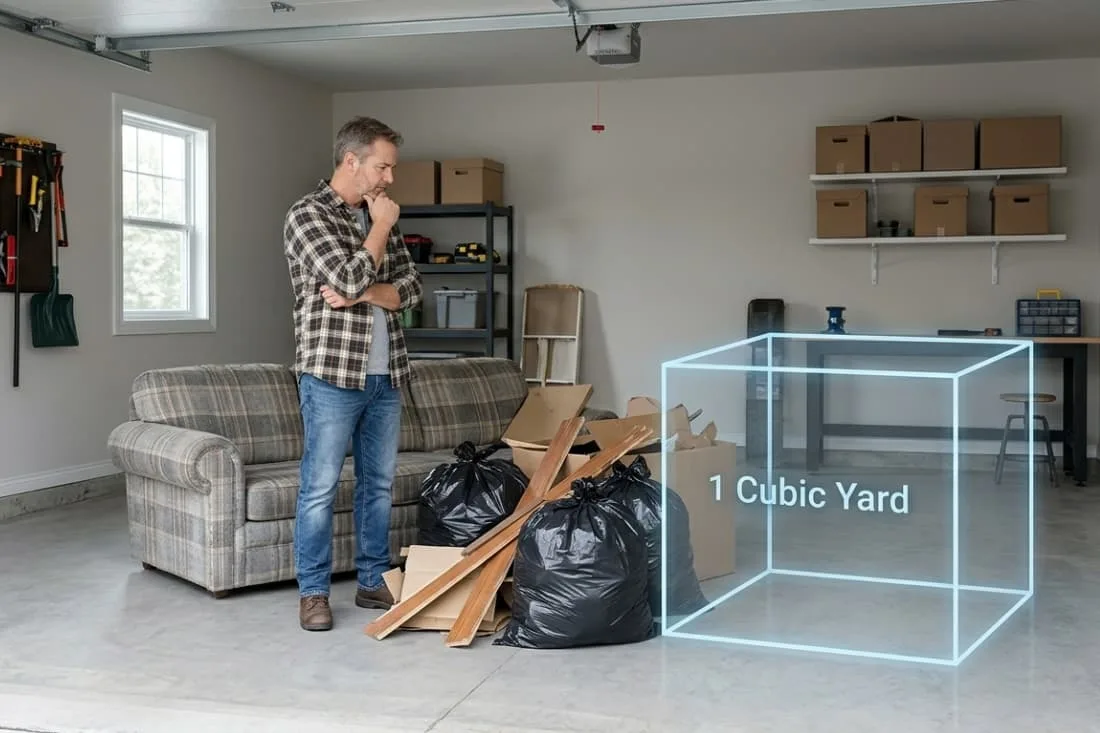
You can make a good estimate of how many cubic yards of waste your project will produce with a few simple methods. This helps you get the right skip and price.
Simple methods for estimating waste volume
The bin bag estimate. Think about how many standard black bin bags your waste would fill. One cubic yard holds roughly ten loosely filled bags, which is a simple starting point when you estimate waste volume for most household projects.
If your job will create about 40 bin bags, you'd need a skip with around 4 cubic yards of capacity. This works well for general household and garden waste.
For soil or rubble (using feet). Estimate the pile's length, width, and average depth in feet. Multiply these three numbers to get the volume in cubic feet, then divide by 27 (the number of cubic feet in a cubic yard). For example, a pile 9ft long, 6ft wide, and 2ft deep is 108 cubic feet, which is 4 cubic yards.
For soil or rubble (using metres). Measure in metres: length x width x height gives you cubic metres. Multiply that figure by 1.3 to convert it to cubic yards. This helps if your project plans are in metric units.
FAQ
Skip size in cubic yards measures the total cubic volume a skip can hold. It shows how much waste material fits inside the container. Most skip hire providers use standard measurements to define yard skips. Understanding cubic yards helps you match your waste types, bin bags, and bulky waste to the correct skip size.
You should choose a skip size based on your waste type, project scale, and available space. Mini Skips work well for small DIY projects and garden work. A Midi Skip suits garden clearances and domestic waste. Builders Skip options handle building work and heavy materials. Larger skips are suitable for construction projects and full house clearance jobs.
The number of bin bags depends on the skip size and its cubic volume. Mini Skips usually hold around 25 to 35 bin bags, while a Midi Skip can hold 40 to 60. Builders Skip options often take 70 to 100 bin bags. These estimates vary depending on waste material, bulky waste, and how efficiently you load the skip.
You can place most domestic waste, garden waste, construction debris, and building waste into skips. However, hazardous materials and hazardous items are not allowed in standard skip hire. You must follow local council regulations and waste management guidelines. Proper waste segregation improves recycling rates and reduces the environmental impact of waste disposal.
You need a permit if you place a skip on public roads or outside your private property boundary. The local council manages the permitting process and may require a waste carrier license. Many skip hire providers assist with permits and delivery logistics. Planning ahead ensures smooth rubbish removal and prevents delays in your project timeline.
Use Cubic Yards to Plan Smarter, Not Harder
Understanding skip sizes in cubic yards gives you control. It removes guesswork, helps you budget accurately, and lets you plan efficiently, like placing heavy materials first to maximize space while staying within weight limits.
Without this knowledge, it is easy to overpay or underprepare. But with a clear estimate, your project runs smoother from start to finish.
Start your Skip Hire Search to connect with verified local providers and choose the right skip with confidence.
References
Related Articles
Filed under:
Skip Sizes