Skip hire is one of the most practical ways to handle a house clearance. Whether you're clearing out a full property, emptying a garage, or finishing a home renovation, hiring a skip gives you a straightforward way to get rid of large amounts of waste in one go.
If you're trying to figure out which skip to use, how much it costs, or what you can actually put in one, keep reading, we've covered it all below.
Skip Hire Essentials at a Glance
Planning your skip hire properly can save time, reduce costs, and make your entire house clearance far easier to manage from start to finish.
Choosing the right skip size is the most important step in a house clearance, too small and you'll need a second collection, too large and you're paying for space you don't use.
Skip hire prices vary depending on your location, skip size, and whether you need a permit for a skip placed on a public road.
Most general household waste, furniture, and garden rubbish can go in a standard skip, but there are a few items that always need to be disposed of separately.
What Is Skip Hire and How Does It Work
Skip hire is a waste removal service where a skip lorry delivers a large metal container to your property or the roadside near it. You fill it with waste at your own pace, and then we come back to collect it and take it away for proper disposal.
It's a popular choice for house clearances, home renovations, garden clearances, and any job that produces more rubbish than your regular bin collection can handle.
The process is simple from start to finish. Here's what typically happens when you book a skip:
You choose a skip size based on the amount of waste you're expecting.
We arrange a delivery date and drop the skip at your chosen location.
You fill the skip over a set hire period, usually between seven and fourteen days.
We collect the skip when you're done or at the end of your hire period.
The waste is sorted at a licensed facility, with as much as possible recycled or recovered.
If you need the skip gone sooner, same day skip hire is available in many areas. If you're not sure how much waste you'll have, it's usually better to go slightly larger rather than smaller, overfilling a skip isn't allowed for safety reasons during transport.
Why House Clearances Call for a Skip

A house clearance can produce a surprising amount of waste. Even a modest flat clearance can fill several van loads with old furniture, broken appliances, bags of general rubbish, and items that have just built up over the years.
Research from UK Parliament shows,
“In the year April 2024 to March 2025, local authorities in England recorded 1.26 million incidents, a 9% rise on the previous year. Household waste accounted for 62% of these. Highways, including roads and pavements, were the most common locations, representing 37% of incidents.” — House of Commons Library from Parliament of UK
Having a skip on site means you have somewhere to put everything as you go, rather than having to make multiple trips to a tip or waiting for a bulky waste removal collection.
Skip hire works particularly well for the following types of clearance jobs, especially during home renovation waste removal or larger property clear-outs. Each of these situations creates a volume of waste that's difficult to manage without a dedicated container:
Full house clearance: Clearing out an entire property, including furniture, soft furnishings, kitchen waste, and general rubbish.
Loft clearance: Old boxes, insulation, timber offcuts, and stored items that have accumulated for years.
Garage clearance: Broken tools, old paint tins, scrap metal, timber, and miscellaneous junk.
Shed clearance: Garden equipment, compost bags, old plastic furniture, and general waste.
End of tenancy clearance: Clearing a rented property before handing back the keys, including items left by previous tenants.
Flat clearance: Smaller volume jobs that still produce more waste than a standard bin collection can handle.
For any of these jobs, having a skip on site removes the need to transport rubbish yourself, which saves both time and fuel costs.
Choosing the Right Skip Size
Getting the skip size right makes the whole job easier. A skip that's too small means you'll run out of space before the clearance is done.
A skip that's too large means you're paying for capacity you don't fill. Here's a breakdown of the most common skip sizes and what they're suited to.
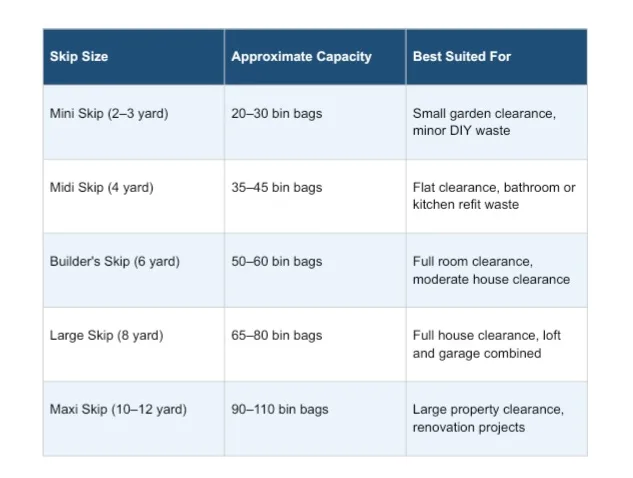
For a typical house clearance covering multiple rooms, a 6 yard or 8 yard skip is usually the most practical choice. If you're also doing building work, such as a kitchen renovation or bathroom renovation, you may need a larger skip to account for the extra rubble, plasterboard, and timber waste on top of the general household rubbish.
What Can Go in a Skip?
Knowing what you can and can't put in a skip saves a lot of hassle. Most standard household waste is fine to put in a general waste skip, including the kinds of items that come up during a typical house clearance.
The following types of waste are generally accepted in a domestic skip. Always check with us when booking if you're unsure about a specific item:
Furniture, including sofas, beds, wardrobes, and tables
General household rubbish in bags
Carpets, curtains, and soft furnishings
Garden waste, including grass cuttings, branches, soil, and green waste from a typical garden clearance project
DIY waste such as timber, wood offcuts, and plasterboard
Rubble, bricks, and concrete in smaller quantities
Metal waste including old radiators, pipes, and scrap items
Mixed waste from kitchen or bathroom refits
“England is currently responsible for generating roughly 85 percent of household waste in the United Kingdom each year. Household waste is treated in a number of different ways, including landfilling, incineration, and recycling.” — Department for Environment, Food & Rural Affairs (DEFRA), via Statista
Some items cannot go in a standard skip and need to be disposed of through specialist channels. These include asbestos, gas cylinders, paint tins with liquid paint still in them, tyres, fridges and freezers (due to the refrigerant gas they contain), and any hazardous chemical waste. If you have items like these, let us know when you book and we can advise on the best way to handle them.
Do You Need a Skip Permit?
Whether you need a permit depends entirely on where the skip will be placed. If the skip sits on private land, a driveway, a private car park, or within the boundary of your property no permit is needed. If the skip needs to go on a public road or pavement, you'll need a skip permit from your local council before delivery.
We handle the permit application process on your behalf in most cases, so you don't have to deal with the council paperwork yourself. Permit costs and processing times can vary by area. In areas like Greater London, the permit requirements and associated fees tend to be stricter than in more rural parts of the country. In counties like Kent or West Midlands, the process is generally the same but lead times and costs may differ slightly.
Here are a few things worth knowing about permits:
Permits take time to be approved, so plan ahead if you're placing a skip on a public road.
The skip will need to display lights or reflective markings if it's positioned on a road.
You may need to notify neighbours if the skip will block access to shared spaces.
Permits are typically valid for a set period, usually around four weeks.
If you're planning a house clearance in a built-up area where driveway space is limited, it's worth confirming the permit situation when you book so there are no delays on delivery day.
How Much Does Skip Hire Cost
Skip hire prices vary depending on the size of the skip, your location, how long you need it for, and whether a road permit is required. As a general guide, smaller skips for domestic use cost between £110 and £250 for a mini skip, while a standard 6 yard builder's skip typically costs between £200 and £340. Large skips for full house clearances can run from £280 to £450. All of these prices exclude VAT.
Location plays a significant role in the final price. Skip hire costs in Greater Manchester or West Midlands will often differ from prices in rural areas or outer counties where transport distances are longer. Permit costs are an added expense on top of the skip hire price when a road placement is needed.
A few factors that affect the overall cost of skip hire include:
Skip size: Larger skips cost more but offer better value per cubic yard for bigger jobs.
Hire duration: Standard hire periods are usually around seven to fourteen days; longer periods may cost extra.
Location: Prices reflect local demand, operating costs, and disposal fees in your area.
Permit fees: If a road permit is needed, the council fee is usually passed on to you.
Waste type: Certain materials like plasterboard or soil may attract an additional disposal charge.
Getting a quote before you book is the best way to get an accurate price for your specific job. We provide transparent pricing with no hidden fees so you know exactly what you're paying before the skip arrives.
Tips for Getting the Most Out of Your Skip
Making smart use of your skip hire saves money and avoids problems during collection. A well-loaded skip is safer to transport and means you get full value from the space you've paid for.
These practical tips will help your clearance run more smoothly. A bit of planning before you start loading goes a long way:
Break down bulky items: Dismantling flat-pack furniture, bed frames, or wardrobes before loading means you can fit significantly more in the same skip.
Load heavy items first: Put rubble, bricks, and heavy waste at the bottom and lighter items on top for a more stable, efficient load.
Don't overfill: Skips must not be filled above the top rim. An overfilled skip can't legally be collected, and you may be asked to remove waste before we can take it.
Keep a clear path: Make sure the skip is accessible for the collection lorry when it arrives.
Sort as you go: If you have recyclable materials like metals or clean timber, keeping them separate may reduce your overall disposal costs.
Check the hire period: If your clearance is taking longer than expected, contact us to extend the hire rather than letting the skip sit overdue.
Skip Hire vs Other Waste Removal Options
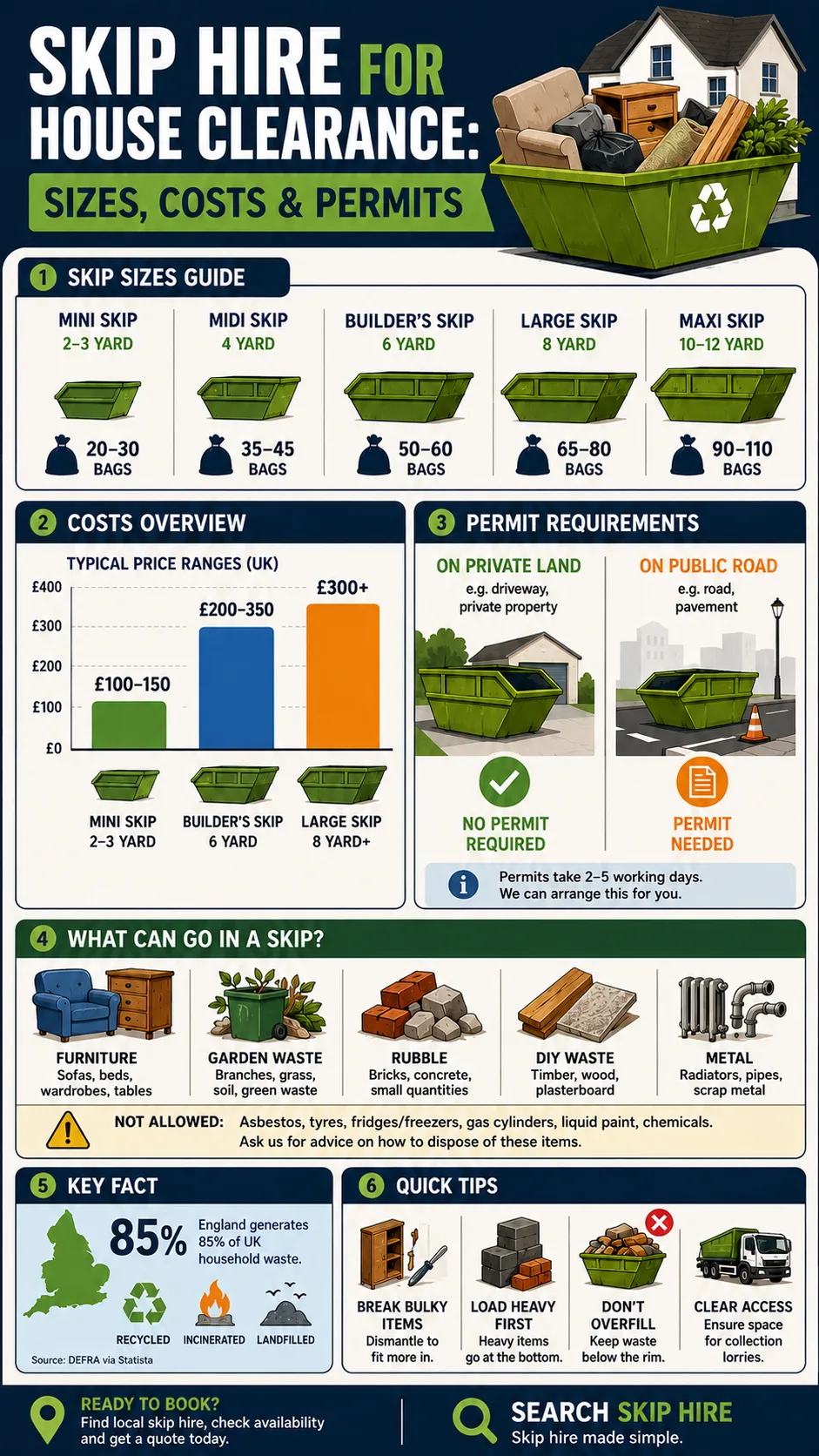
Skip hire isn't the only way to deal with house clearance waste, but it's often one of the most practical domestic skip hire options for larger jobs. It's worth knowing how it compares to the alternatives so you can choose the right approach for your situation.
For smaller volumes of waste a single room clear-out or a few large items a wait and load service or a man and van rubbish removal option might be more cost-effective.
For very large volumes such as a demolition project or large commercial clearance, a roll on roll off (RoRo) skip may be more suitable than a standard domestic skip.
For most house clearances, standard skip hire sits in the middle, it gives you the flexibility to work at your own pace, it handles mixed waste, and the cost is predictable from the start.
FAQ
For most house clearances, a 6 yard builder’s skip or an 8 yard large skip is the best option. Smaller clearances like a garage or flat may only need a 4 yard midi skip, while larger properties or renovation projects may require a 10–12 yard maxi skip.
Most skip hire companies offer a standard hire period of 7 to 14 days. If you need the skip for longer, you can usually extend the hire period for an additional cost by contacting the provider before collection.
Yes, most household waste can go into a skip, including furniture, carpets, wardrobes, sofas, beds, general rubbish, garden waste, and DIY materials. However, hazardous items such as asbestos, tyres, fridges, gas cylinders, and liquid paint are not allowed in standard skips.
You only need a permit if the skip is being placed on a public road or pavement. If the skip is kept on private property such as a driveway, no permit is required. In most cases, the skip hire company can arrange the permit on your behalf.
Skip hire prices depend on the skip size, your location, hire duration, and whether a permit is needed. Mini skips usually cost between £110 and £250, while large skips for full house clearances can cost between £280 and £450, excluding VAT.
Your Next Step for a Stress-Free House Clearance
Skip hire is one of the simplest ways to manage a house clearance without the stress of multiple tip runs or unreliable collections. Whether you need a small skip for a flat clearance or a large skip for a full property clear-out, getting the right size at the right time makes the whole job far easier to manage.
If you're in an area like Greater London, Kent, West Midlands, or anywhere else across the UK, we can help you find the right skip for your job. Head to Search Skip Hire to find local skip hire options, check availability, and get a quote today.
References
https://commonslibrary.parliament.uk/research-briefings/sn05672/
https://www.statista.com/topics/4908/household-waste-in-england/#statisticChapter
Related Articles
Filed under:
Domestic Skip Hire