
Hiring a skip is one of the most practical ways to handle a loft clearance. It is one of the most common domestic skip hire solutions for dealing with large amounts of household waste, giving you a designated space to load unwanted items at your own pace without needing multiple trips to the tip.
If you are planning a loft clear-out and want to know how skip hire works, what size to choose, and how much it will cost, keep reading, we have covered everything below.
Loft Clearance Quick Wins
Planning a loft clearance is much easier when you know the basics upfront. These quick points cover the most important things to consider before hiring a skip, from choosing the right size to avoiding extra costs and delays.
Choose the right skip size. Loft clearances usually create more waste than expected. A mini or midi skip works for many standard lofts, but heavily packed lofts may need a larger option.
Check whether you need a permit. If the skip will sit on a public road or pavement, you will normally need a council permit. Skips placed on private driveways usually do not require one.
Sort your waste before loading. Some items cannot go in a skip, including certain electrical goods, hazardous materials, and gas cylinders. Sorting beforehand helps avoid delays and additional charges.
What Is Involved in a Loft Clearance
A loft clearance typically involves removing items that have been stored away for years, sometimes decades. Old furniture, boxes of clothing, broken appliances, children's toys, Christmas decorations, insulation offcuts, and general household clutter all tend to build up in loft spaces over time.
The volume of waste generated by a loft clearance can surprise many people. What looks like a manageable amount of items when you first look up into the loft often turns out to be far more once everything is brought down.
This is one of the reasons why having a skip on site before you start is such a good idea, you can load items as you bring them down, rather than piling them up in a hallway or spare room first.
A skip gives you flexibility. You can work through the loft over a few days and keep adding to the skip as you go, rather than trying to get everything out and disposed of in a single session.
What Skip Size Do You Need for a Loft Clearance
Choosing the right skip size is important. Going too small means you will run out of space before the job is done. Going much too large means you are paying for capacity you do not use.
Here is a breakdown of the most common skip sizes and how they relate to loft clearance jobs:
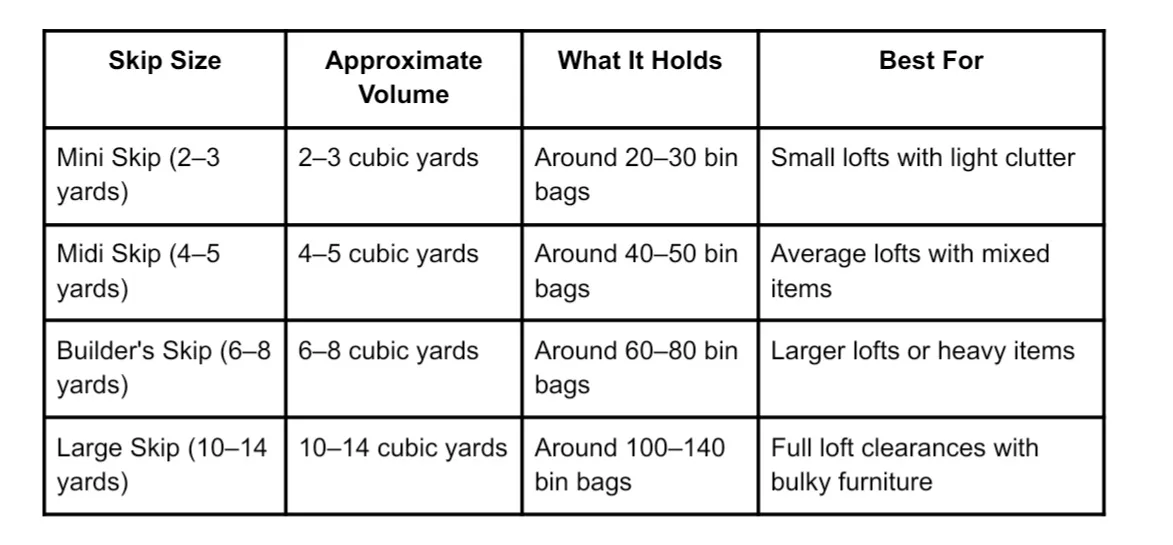
Most standard loft clearances fall somewhere between a midi skip and a builder's skip. If your loft contains large items like old wardrobes, mattresses, or heavy boxes, it is worth sizing up rather than down, especially in situations similar to a house clearance where bulky waste quickly adds up.
Overfilling a skip is not allowed,items must not be loaded above the top rim of the skip, so it is better to have a little extra room than to run short.
If you are unsure about the size, it is always worth speaking to us before you book. We can help you estimate based on what you describe, and we would rather help you get it right the first time than have you stuck with a skip that is too small.
Where to Place a Skip for a Loft Clearance
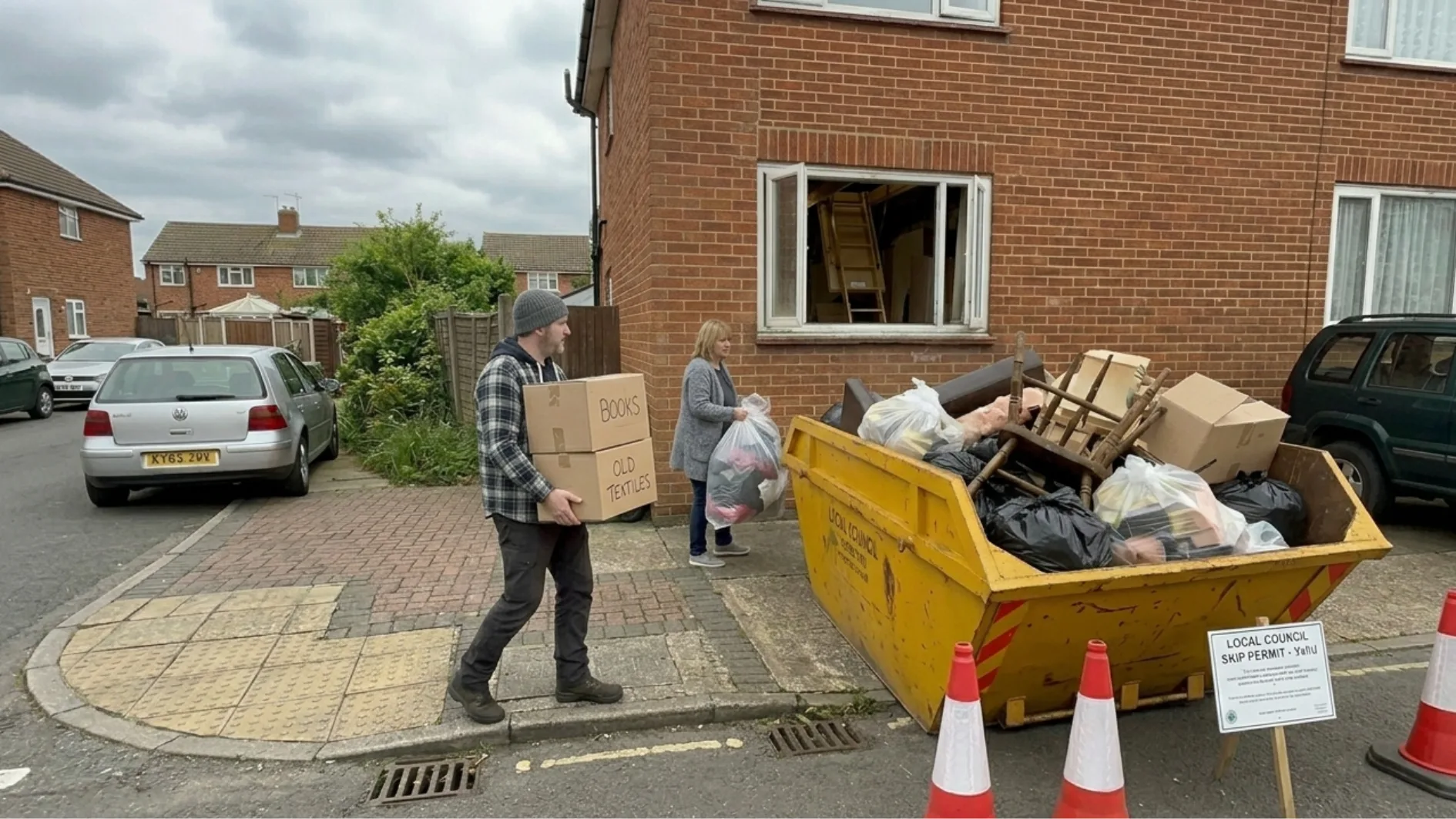
Where you put the skip matters more than most people initially think. The closer the skip is to your property, the easier the loading process will be, especially when you are carrying items down from a loft.
On your driveway or private land: This is the simplest option. If you have a driveway or a private area outside your home, placing the skip there means you do not need any permits. You can load at any time without worrying about council restrictions.
On a public road or pavement: If your property does not have a driveway, or if you need the skip closer to a side entrance, you may need to place it on the road or footpath. In this case, you will need a permit from your local council before the skip is delivered. The permit requirement applies across the UK, whether you are in Greater London, Greater Manchester, or more rural counties like Kent.
Practical tips for skip placement:
Make sure there is enough space for the skip lorry to access the area safely when delivering and collecting
Avoid placing skips on soft ground like lawns where possible, as the weight can cause damage
Keep a clear path between your front door and the skip so you can move items quickly and safely
If the skip is on the road, check with us about any lighting or marking requirements, as these vary by area
What Can and Cannot Go in a Skip for a Loft Clearance
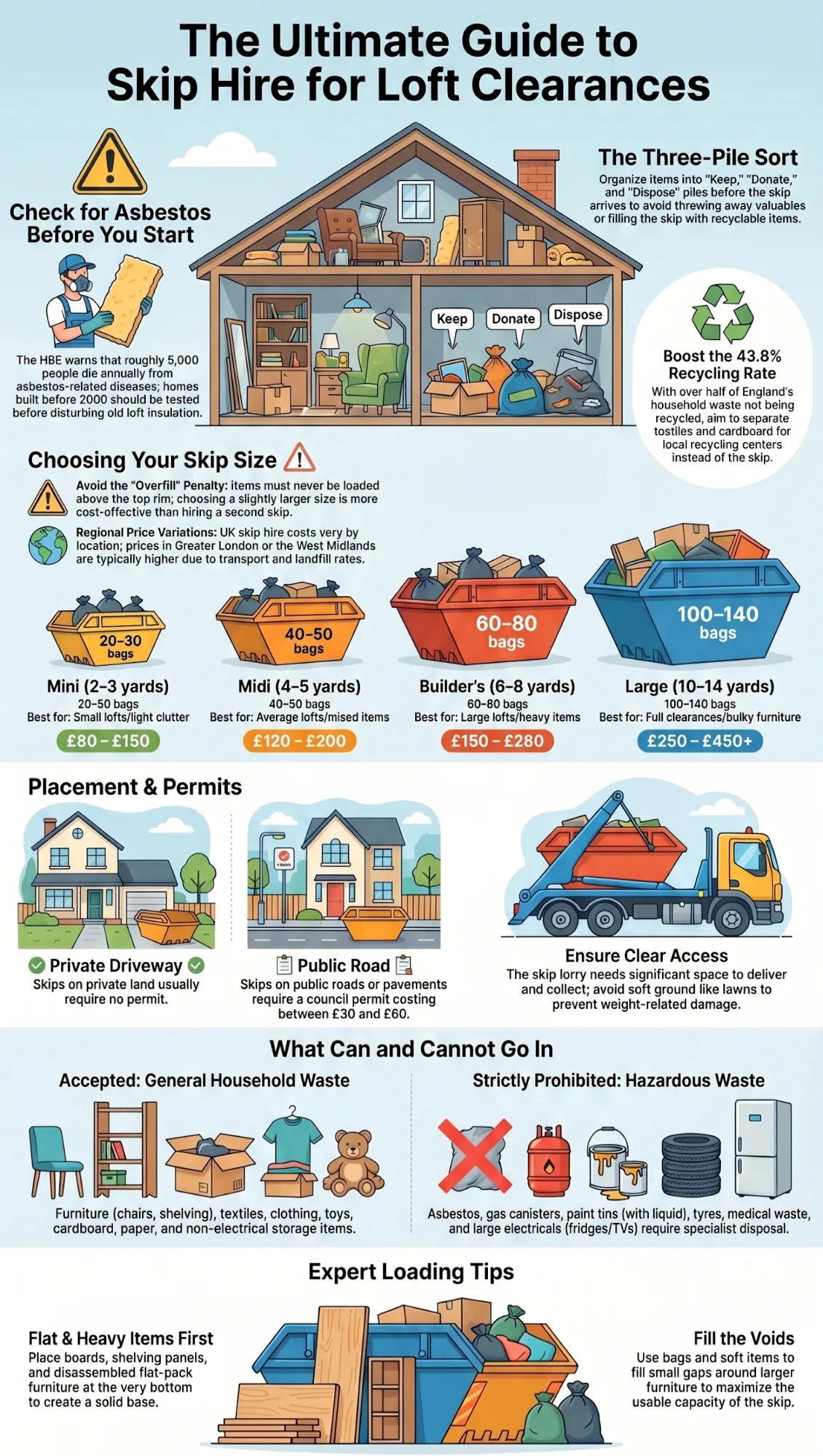
Understanding what is and is not allowed in a skip saves time and avoids unnecessary issues. The rules apply nationally, though local handling arrangements can sometimes differ slightly. It is also worth keeping in mind that how we handle waste matters beyond just the job at hand. According to the Department for Environment, Food and Rural Affairs (DEFRA):
"The official England waste from households recycling rate was 43.8% in 2024." — DEFRA, Local Authority Collected Waste Management Annual Results 2024/25
That figure means well over half of household waste in England is still not being recycled. A loft clearance is a good opportunity to do things right, separating items that can be donated, recycled, or reused before anything goes in the skip.
Most loft clearance waste is perfectly fine to put in a skip. The following items are generally accepted:
General household clutter and packaging
Old furniture including chairs, shelving units, and flat-pack pieces
Clothing and textiles
Books, toys, and ornaments
Cardboard and paper
Non-electrical storage items
Broken items that cannot be donated or sold
However, there are items that cannot go into a skip under any circumstances. These include:
Asbestos, this requires specialist removal and disposal, and it is worth checking older loft insulation before starting work
Hazardous chemicals, paint tins with liquid paint, or solvents
Gas canisters or cylinders
Tyres
Clinical or medical waste
Large electrical items in some cases, televisions, fridges, and monitors may require separate disposal depending on the skip provider
If you are unsure about a specific item, the best approach is to ask us before loading. It is much easier to make arrangements for a particular item in advance than to have it pulled from the skip on collection day.
How Much Does Skip Hire Cost for a Loft Clearance
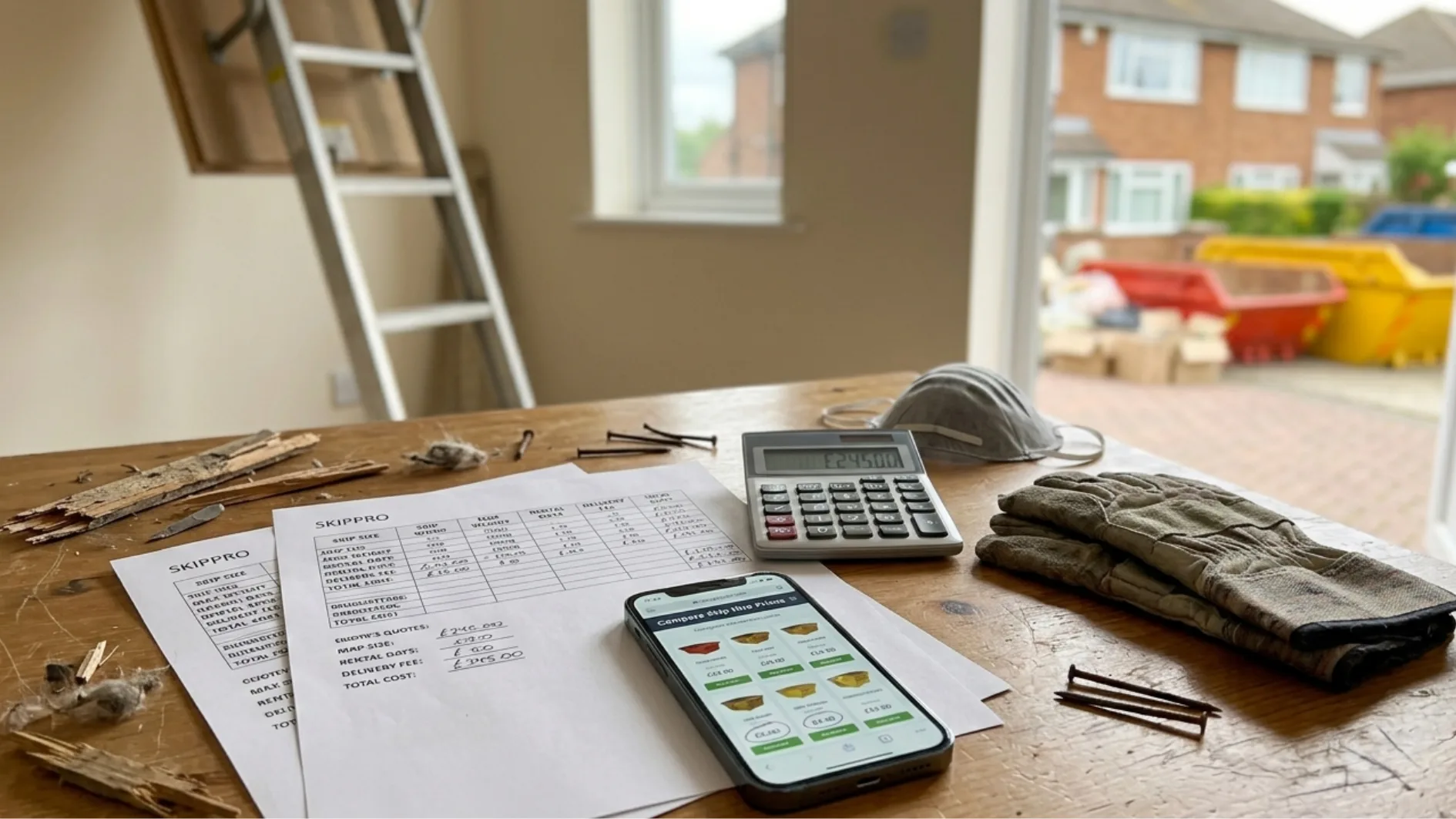
Skip hire prices in the UK vary depending on your location, the skip size, and how long you need the skip. On average, you can expect to pay somewhere in the following ranges, excluding VAT:
Mini skip (2–3 yards): Roughly £110 to £250
Midi skip (4–5 yards): Roughly £150 to £310
Builder's skip (6–8 yards): Roughly £200 to £340
Large skip (10 to 12 yards): Roughly £280 to £450
These are general estimates. Prices in areas like Greater London or the West Midlands can be higher than in less densely populated parts of the UK, due to differences in transport costs, local landfill rates, and permit fees.
If you need a skip placed on a public road, the permit cost is set by each council: across the 197 UK highway authorities we have checked, half charge between £40 and £90, with a typical figure of about £62, though they run from £12.40 to £260. We handle the permit application on your behalf in most cases, so you do not need to deal with the council directly.
Hire periods usually run from 7 to 14 days, which is more than enough time for a standard loft clearance. If you need the skip for longer, extensions can usually be arranged.
How to Prepare for Your Loft Clearance Before the Skip Arrives
Getting a few things in order before your skip is delivered will make the whole process smoother and safer.
Good preparation before the skip arrives will save time and help you avoid unnecessary issues during the clearance. Here are some steps worth taking:
Inspect your loft insulation. Older homes, particularly those built before the mid-1980s, may contain asbestos in the insulation. If you are not sure, have it tested before you start pulling things apart. This is a safety issue, not just a disposal one. The Health and Safety Executive (HSE) is clear on this point:
"Around 5,000 people die every year from asbestos-related diseases which typically take decades to develop and cannot be cured." — Health and Safety Executive (HSE)
This is not something to take lightly. If your home was built before 2000, it is worth getting a proper check done before any work begins in the loft.
Sort items into keep, donate, and dispose piles. Getting organised before the skip arrives helps you make faster decisions and avoids filling the skip with things you later regret throwing away.
Separate items that cannot go in the skip. Set aside any electricals, chemicals, or other restricted items so they do not accidentally end up in the skip.
Have the right equipment on hand. A good torch, dust mask, and sturdy gloves will make working in the loft more comfortable, especially in older properties where dust and debris build up.
Measure access routes. Check that large items like old wardrobes or mattresses can actually fit through the loft hatch and down the staircase before you start moving them.
Permits and Regulations Around the UK
If the skip needs to go on public land, you will need a permit. The process is generally similar across the UK, but timelines and fees vary between councils.
In areas like Greater London, permit applications may take slightly longer to process due to volume, so it is worth booking your skip with enough lead time. In parts of the West Midlands or Kent, turnaround times may be faster, but it is still advisable not to leave it to the last minute.
When you book with us, we ask for the placement details during the booking process and take care of the permit application where required. The permit fee is added to the total cost transparently, with no hidden charges.
It is also worth noting that overfilled skips can be refused on collection or may result in additional charges. Make sure items are loaded flat and do not exceed the fill line marked on the skip.
Tips for Loading a Skip Efficiently
Loading a skip well means you get more out of the space you are paying for. A randomly loaded skip wastes a significant amount of usable capacity.
Loading your skip in the right order and the right way makes a real difference to how much you can fit in. The same approach is often used during garden clearance jobs, where bulky and uneven waste can quickly waste skip space if it is not loaded carefully. Here are some practical loading tips to keep in mind:
Start with flat, heavy items at the bottom things like boards, shelving panels, and flat-pack furniture pieces
Fill gaps with smaller items and bags as you go
Break down bulky items where possible before loading them, chairs and shelving units often take up far less space once disassembled
Load bags and soft items around and on top of heavier pieces to fill in the spaces
Avoid just throwing everything in a little care while loading can increase usable skip capacity by a meaningful amount
FAQ
You only need a permit if the skip will be placed on a public road or pavement. If the skip is kept entirely on your driveway or private land, a permit is usually not required. Most skip hire companies can arrange the permit for you if needed.
For most loft clearances, a midi skip (4–5 yards) or builder’s skip (6–8 yards) is usually the best choice. Smaller lofts with minimal clutter may only need a mini skip, while larger lofts with bulky furniture or years of stored items may require a larger option.
Certain items are restricted and cannot be placed in a skip, including asbestos, hazardous chemicals, gas cylinders, tyres, and some electrical appliances such as fridges or televisions. Always check with your skip provider if you are unsure about a specific item.
Most skip hire periods in the UK last between 7 and 14 days, which is normally enough time for a loft clearance. If you need more time, many providers can arrange an extension for an additional fee.
The cost depends on the skip size, your location, and whether you need a permit. In general, prices range from around £110 for a mini skip up to £450 for a large skip, excluding VAT. Permit costs for skips on public roads are usually charged separately.
Your Next Step for a Hassle-Free Loft Clearance
Skip hire for a loft clearance does not need to be complicated. Once you know the right size for your job, where the skip will go, what can and cannot go in it, and how permits work, the rest of the process is straightforward.
We make it easy to find the right skip for your loft clearance, wherever you are in the UK. Whether you are based in Greater Manchester, Kent, or anywhere else across the country, you can check availability and get a quote quickly without any hassle.
Ready to get started? Visit Search Skip Hire to find skip hire options in your area and book the right size for your loft clearance today.
References
Related Articles
https://www.searchskiphire.co.uk/blog/domestic-skip-hire/domestic-skip-hire-use-cases/
https://www.searchskiphire.co.uk/blog/domestic-skip-hire/skip-hire-for-house-clearance/
https://www.searchskiphire.co.uk/blog/domestic-skip-hire/skip-hire-for-garden-clearance-uk/
Filed under:
Domestic Skip Hire