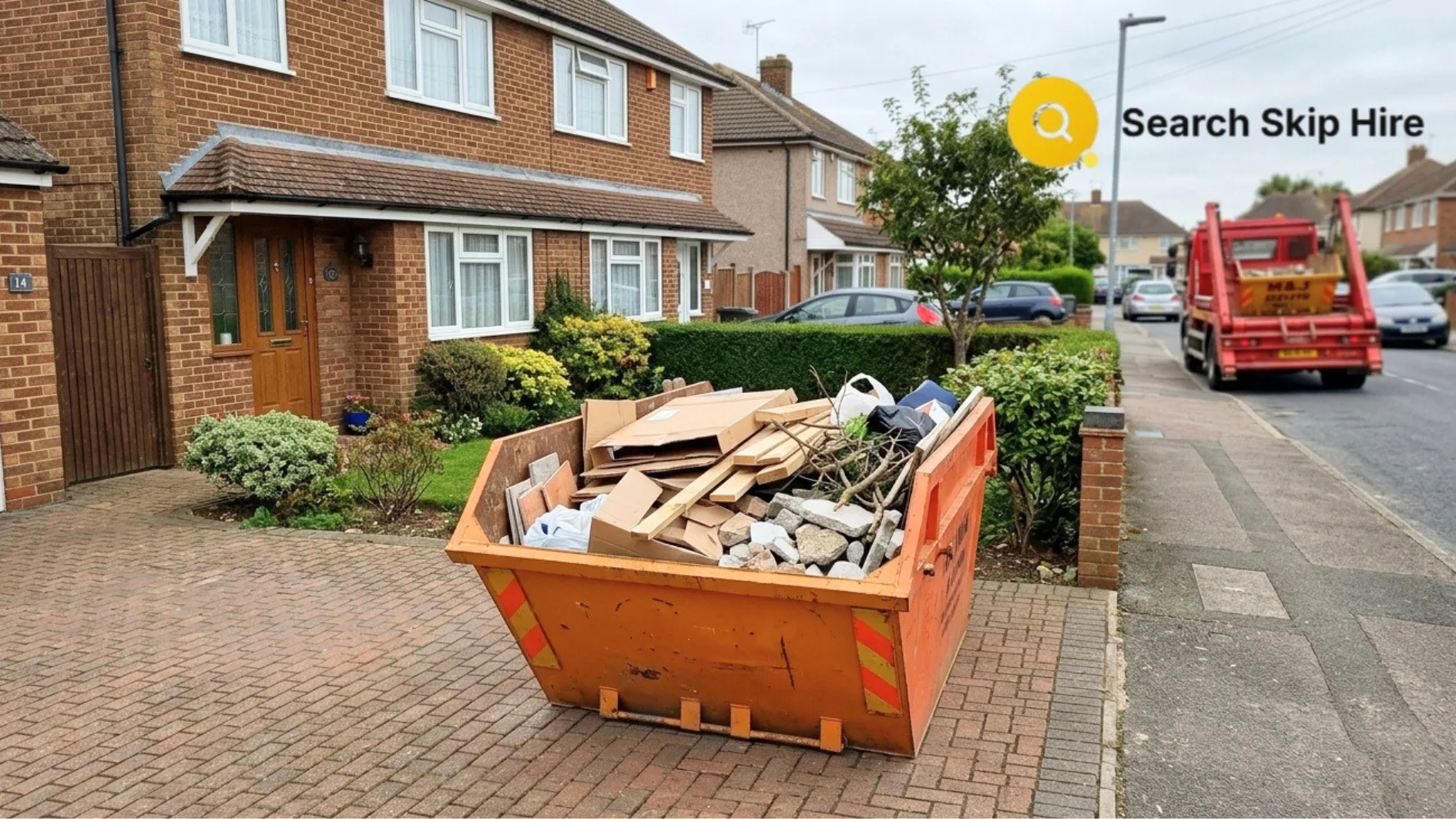
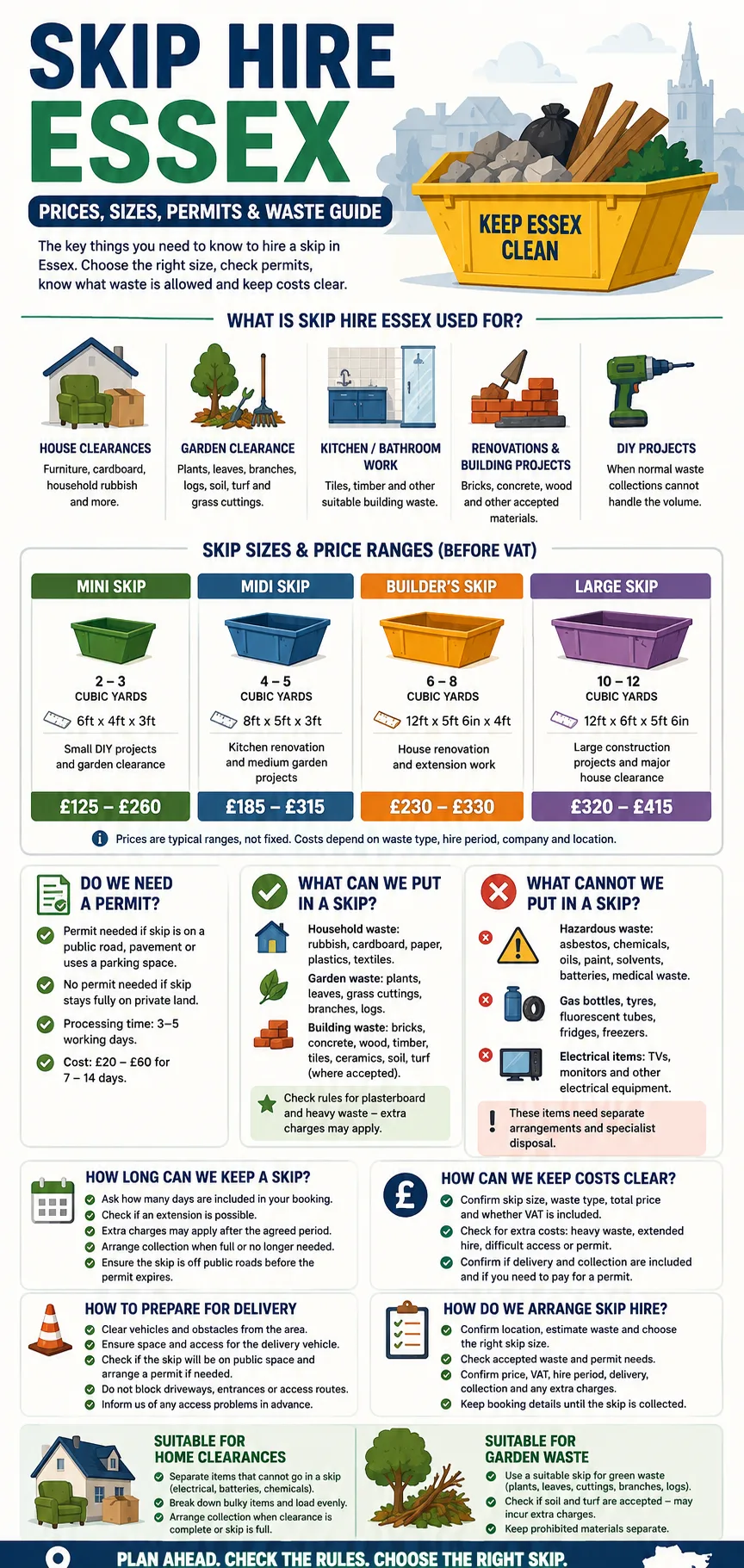
We can hire a skip in Essex for household clearances, garden work, renovations, building jobs, and other projects that create large amounts of waste. We can choose from several skip sizes, with current listed prices ranging from £125 to £415 before VAT.
We also need to check whether a permit is required, what waste we can place inside, and how long we can keep the skip. Reading the points below helps us plan skip hire clearly before we arrange delivery.
Quick Skip Hire Essex Essentials
This quick summary covers the main points we need to know before arranging a skip for any project.
We can choose from mini, midi, builders, and large skips based on the amount of waste we expect to produce.
Current listed prices range from £125 to £415 before VAT, depending on skip size and other booking details.
We may need a permit when the skip sits on a public road, pavement, verge, or parking space.
What Is Skip Hire Essex Used For?
We can use skip hire when our project produces more waste than we can manage with normal household collections. A skip gives us one place to put suitable waste while work continues. This can make larger clearances and building work easier to manage.
The right use depends on the type and amount of waste we create. We should also check the waste rules before the skip arrives because some materials cannot go into a standard skip.
We commonly use skips for the following types of work.
We can use a skip during a house clearance when we have furniture, cardboard, household rubbish, and other suitable waste.
We can use a skip for garden clearance involving plants, leaves, branches, logs, soil, turf, and grass cuttings.
We can use a skip during kitchen or bathroom work when the project creates tiles, timber, and other suitable building waste.
We can use a skip during larger renovation work when we need space for bricks, concrete, wood, and other accepted materials.
We can use a skip for general DIY projects when our normal waste collection cannot handle the volume.
Which Skip Size Should We Choose?
Choosing the right skip size helps us manage waste without paying for more space than our project needs. We should estimate the waste before booking.
The current listed skip sizes and price ranges are shown below.
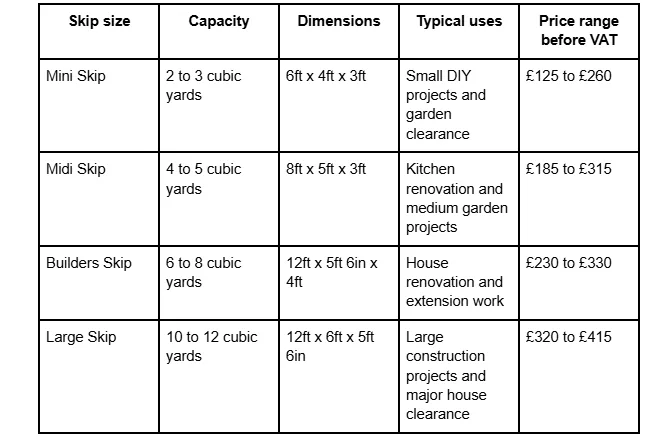
The published prices are typical ranges rather than fixed prices. Exact costs can change according to the waste type, hire period, company, and delivery location.
We can use these simple points when deciding which size fits our project.
We can consider a mini skip when our waste comes from a small DIY job or a limited garden clearance.
We can consider a midi skip when our project produces more waste than a mini skip can reasonably hold.
We can consider a builder's skip when we are dealing with a house renovation, extension, or larger building project.
We can consider a large skip when our project involves major construction work or a substantial house clearance.
We should avoid filling a skip above its safe loading level because overloaded skips may not be collected.
How Much Does Skip Hire Essex Cost?
Skip hire costs depend on several parts of the booking, so the skip size alone does not give us the final price. The current published ranges give us a useful starting point.
We should also remember that the listed prices exclude VAT. Waste type, hire length, location, and permit needs can affect what we pay overall.
Several factors can affect the final cost of our skip hire.
We can expect larger skips to have higher starting prices because they provide more waste capacity.
We may pay more when our waste needs special handling or disposal.
We may face extra costs if we need to keep the skip beyond the included hire period.
We may need to pay a permit charge when the skip is placed on a public area.
We may see different prices between locations because delivery costs can vary by postcode and distance.
Do We Need A Skip Permit?
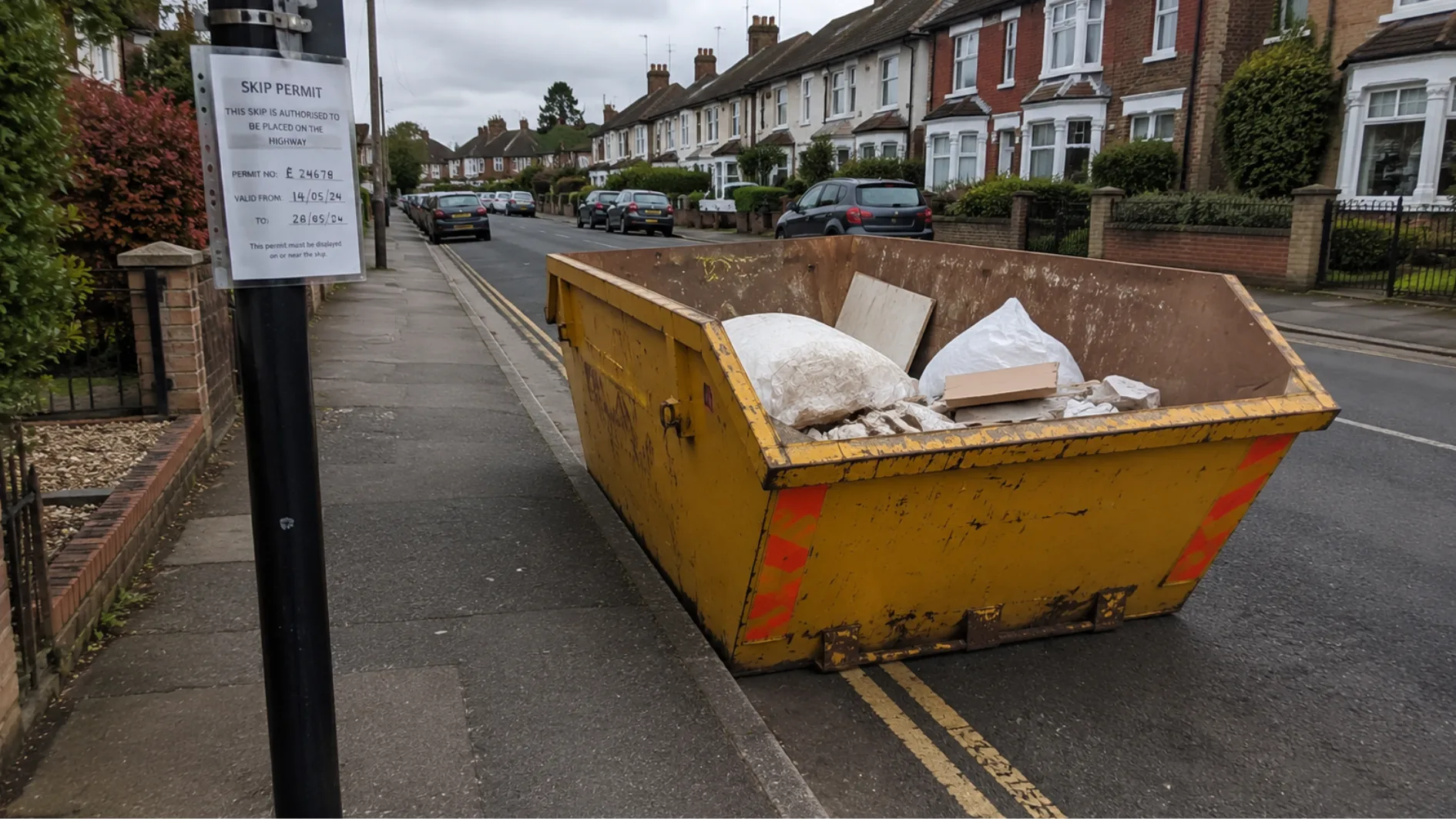
We need to check the placement of our skip before arranging delivery. A permit is generally needed when the skip uses public space rather than private land.
As highlighted by Essex County Council:
"All activities on the highway are controlled using licences. To place skips, scaffolding, hoardings, cranes or cherry pickers on a highway in Essex, you need to apply to Essex County Council. You may do so by selecting the links above depending upon which licence you require." - Essex County Council
We should check these points before delivery.
We need a permit when our skip is placed on a public road.
We need a permit when our skip is placed on a pavement or other public area.
We need a permit when the skip occupies an on-street parking space.
We normally do not need a road permit when the skip stays fully within our private property.
We should allow time for the permit application because the published processing times are generally three to five working days.
Permit costs differ between local areas. The published figures range from £20 to £60, with permit periods generally lasting seven to fourteen days.
What Skip Waste Can We Put Inside?
We should check our waste before loading the skip because accepted materials can vary by waste type and disposal requirements. Ordinary household, garden, and building waste is commonly accepted when the right skip is used.
We should keep unsuitable materials separate and check with our skip hire service if we are unsure about any item.
Commonly accepted waste includes:
Household rubbish, cardboard, paper, plastics, and textiles.
Garden waste such as plants, leaves, grass cuttings, branches, and logs.
Building waste such as bricks, concrete, wood, timber, tiles, ceramics, soil, and turf where accepted.
We should also check the rules for plasterboard, as it may need separate handling. Heavy materials such as soil, rubble, and concrete may also involve additional charges.
What Cannot We Put In A Skip?
Some waste cannot go into a standard skip because it may create safety, environmental, or disposal problems. We should identify these items before the skip arrives.
We should always check with our skip hire service if we are unsure whether a particular item is allowed.
Common items that cannot go into a standard skip include:
Asbestos, chemicals, oils, paint, solvents, batteries, and medical waste.
Gas bottles, tyres, fluorescent tubes, fridges, and freezers.
Electrical items such as televisions, computer monitors, and other equipment that requires separate disposal.
As noted by GOV.UK
"Waste is generally considered hazardous if it (or the material or substances it contains) are harmful to humans or the environment. Examples of hazardous waste include: asbestos, chemicals, such as brake fluid or print toner, batteries, solvents, pesticides,oils (except edible ones), such as car oil, equipment containing ozone depleting substances, like fridges, hazardous waste containers." - GOV.UK
These materials need separate arrangements because standard skip disposal is not suitable for them. Asbestos also requires specialist handling.
How Long Can We Keep A Skip?
The time we can keep a skip depends on the terms of our booking. Some services may allow flexibility when a project takes longer, while others may set a specific hire period.
We should confirm the hire period before delivery so our project schedule matches the booking.
These points can help us avoid problems with the hire period.
We should ask how many days are included in our booking.
We should ask whether an extension is possible if our work takes longer.
We should check whether extra charges apply after the agreed period.
We should arrange collection when the skip is full or when our project no longer needs it.
We should make sure the skip does not remain on a public road after its permit expires.
The published information notes that many skip services use flexible arrangements, but some set a limit of around one to two weeks. We should check the exact terms before booking.
How Can We Prepare For Skip Delivery?
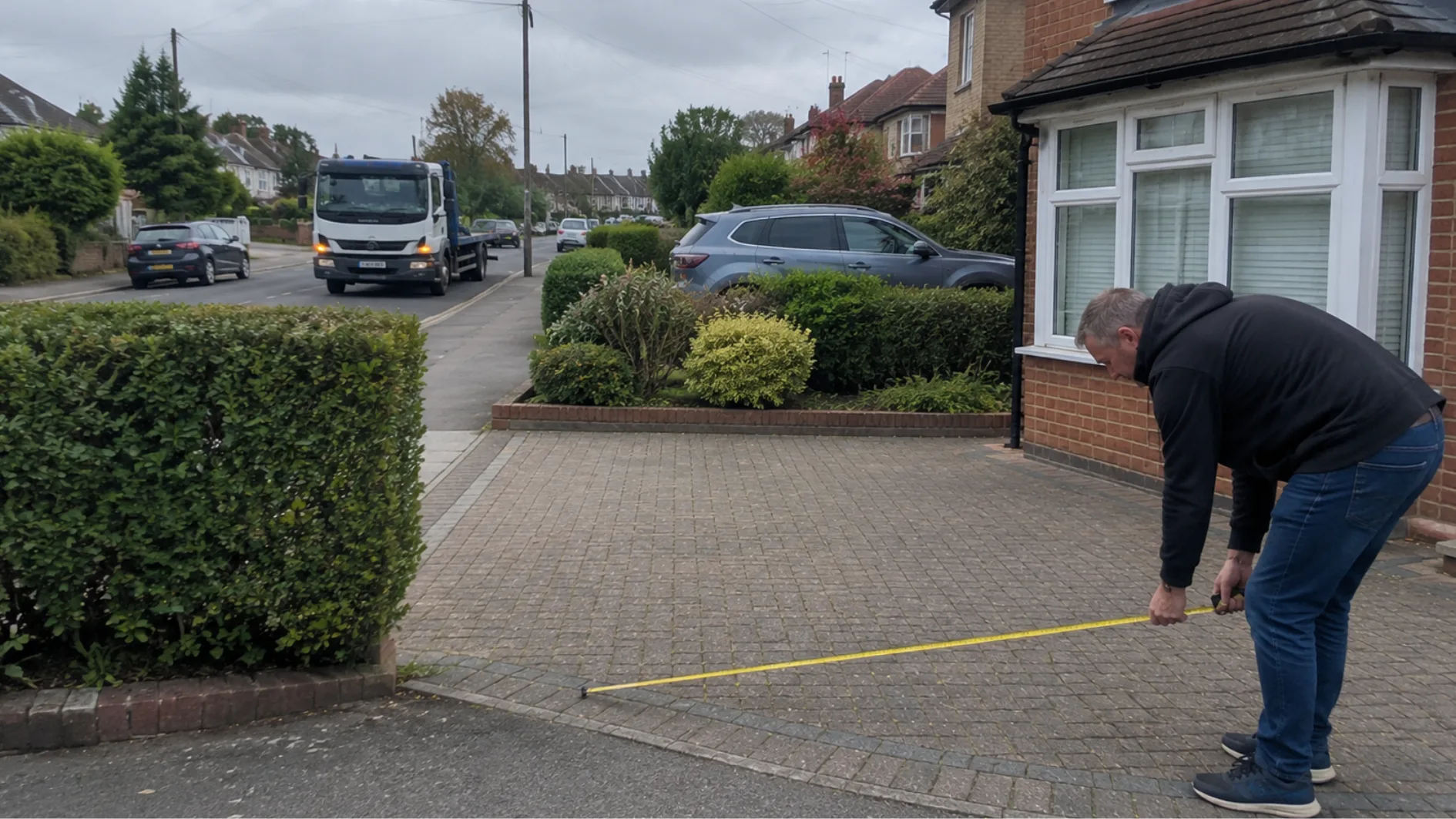
Good preparation helps us make better use of the skip and reduces the chance of delivery problems. We should decide where the skip will go before the delivery date.
We should make sure the area is clear, accessible, and large enough for the skip and delivery vehicle.
We can prepare for delivery with these simple steps:
We should clear vehicles, tools, garden items, and other obstacles from the delivery area.
We should check the available space and make sure the delivery vehicle has enough access, especially where we have a narrow drive or restricted entrance.
We should check whether the skip will be placed on private land or public space and arrange a permit if one is required.
We should avoid blocking entrances, access routes, driveways, or other areas that need to remain clear.
We should also tell our skip hire service about any access problems before delivery. A skip may not be delivered if the planned position cannot be reached safely.
How Can We Keep Skip Hire Costs Clear?
We can make our skip hire costs easier to understand by checking the main booking details before we confirm. The starting price may not include every possible cost. The same basic points can apply when we look at skip hire Eilean Siar as a separate local service.
We should ask for clear information about the skip, waste type, delivery, collection, hire period, VAT, and any permit requirements.
Before booking, we should check:
We should confirm the skip size, waste type, total price, and whether VAT is included.
We should check whether heavy waste, extended hire, difficult access, or other requirements could add to the cost.
We should confirm whether delivery and collection are included and whether we need to arrange or pay for a permit.
Checking these details before delivery gives us a clearer idea of what our skip hire will cost.
How Do We Arrange Skip Hire In Essex?
We can start by choosing the delivery area and checking the available skip hire UK options. This helps us find suitable sizes, prices, and delivery details for our project.
The published directory covers many towns and locations, so we can check the relevant area instead of relying only on a general price.
We can keep the booking process simple:
We should confirm our delivery location, estimate our waste, and choose a skip size that suits the project.
We should check which waste materials are accepted and whether our planned skip position needs a permit.
We should confirm the price, VAT, hire period, delivery, collection, and any additional charges before booking.
We should keep our booking details until the skip has been collected in case we need to check any part of the arrangement.
Is Skip Hire Suitable For Home Clearances?
Skip hire can be suitable for many skip hire for house clearance projects when the waste is allowed in the chosen skip. It gives us a set space for managing a large amount of ordinary household waste.
We should sort our items before loading because some household waste needs separate disposal.
For a home clearance, we can:
Separate ordinary household waste from electrical items, batteries, chemicals, and other materials that cannot go into a standard skip.
Break down suitable bulky items where it is safe and allowed, then load the skip evenly without filling it above the permitted level.
Arrange collection once the clearance is complete or when the skip reaches its safe capacity.
Is Skip Hire Suitable For Garden Waste?
Skip hire can be useful for garden clearance when we have a large amount of accepted green waste. We should check the waste rules before loading because not every material can go into the same skip.
We should also consider the weight of soil and turf because heavy waste can affect the suitable skip type and cost.
For garden projects, we can:
Use a suitable skip for plants, leaves, grass cuttings, branches, and logs where these materials are accepted.
Check whether soil and turf are accepted and whether heavy waste could result in an additional charge.
Keep prohibited materials separate from our garden waste and arrange suitable disposal for them.
FAQ
We can arrange skip hire for many towns and areas by checking the relevant local availability and pricing. We should use our exact delivery location when checking the service.
We can keep a skip for the period agreed during booking. Some services offer flexible collection, while others set a fixed hire period. We should confirm the exact arrangement before delivery.
We cannot place hazardous materials, asbestos, batteries, chemicals, oils, gas bottles, tyres, medical waste, or many electrical items into a standard skip. We should check any uncertain item before loading.
We need a permit when our skip is placed on public roads, pavements, parking spaces, or other public areas covered by local rules. We normally do not need a road permit when the skip stays fully on private property.
We should estimate the amount of waste our project will produce and compare it with the capacity of each skip. A mini skip holds 2 to 3 cubic yards, while a large skip holds 10 to 12 cubic yards.
Skip Hire Essex And Our Next Step
Skip hire gives us a straightforward way to manage suitable waste from clearances, garden projects, renovations, and building work. The main points are to choose the right size, check the waste rules, confirm the full cost, and arrange a permit when our placement requires one.
We should also check access before delivery and confirm how long the skip can remain in place. Current listed prices range from £125 to £415 before VAT, but our final cost can depend on waste type, location, hire length, and other booking details.
For our current skip hire information, available areas, sizes, and pricing, we can continue with our Skip Hire Essex.
References
Related Articles
Filed under:
Skip Hire