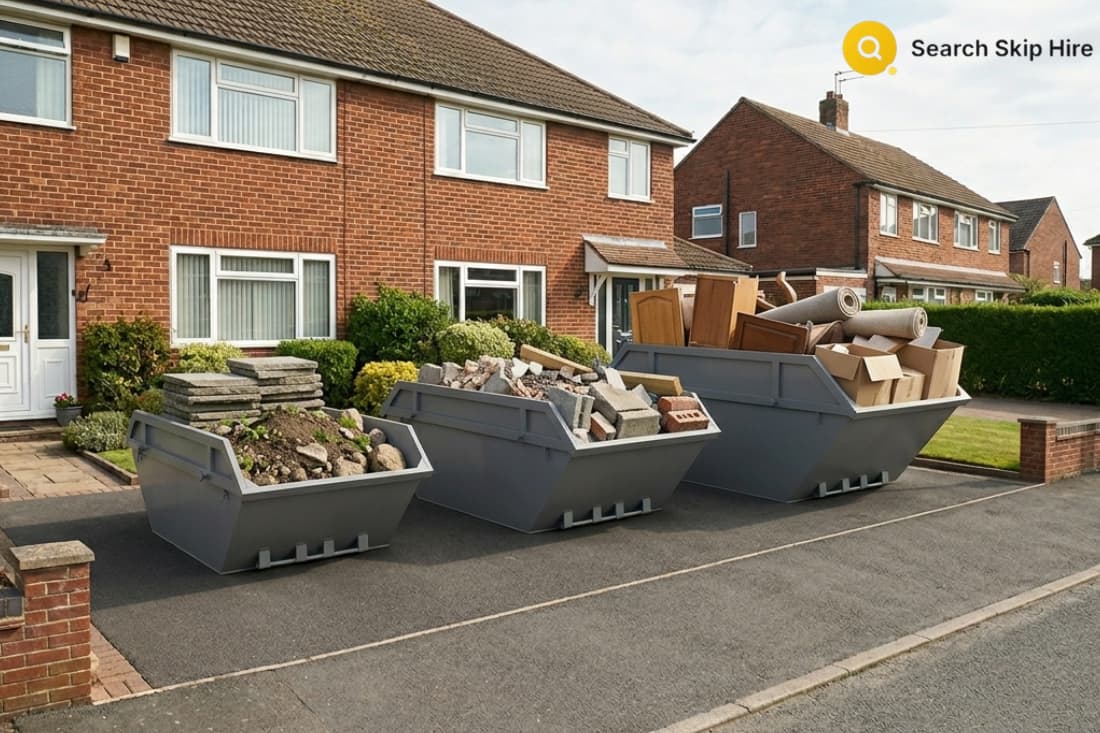
Getting the right skip size means knowing the standard UK capacities and estimating your waste accurately.
For most homes, a skip between four and eight cubic yards will do. The biggest mistake is overloading a skip with heavy materials like soil, which leads to extra charges or a refused collection.
Understanding both volume and weight limits is key to a smooth, cost-effective hire. To learn how to measure your waste and pick the right size, keep reading.
UK Skip Sizing: Quick Rules That Save You Hassle
These key points show how to estimate correctly, choose the right size, and avoid costly mistakes when hiring a skip.
UK skip sizes are measured in cubic yards, with 4-yard and 8-yard skips being the most common for domestic projects.
Estimate waste volume by measuring piles or using everyday references like bin bags and car boots.
Always respect weight limits; overloading a skip with heavy waste is dangerous and leads to extra fees or refusal of collection.
Skip Size Guide for UK Households

UK skip sizes for homes are standard. They go from small two-yard mini skips up to larger eight-yard builders skips, and understanding a proper skip size guide for UK households helps match the right option to your project.
The most common picks for house projects are the four-yard midi skip and the six to eight-yard skip. These handle most home renovations, garden clearances, and DIY jobs.
Research from Newham Council shows
"1-5 people: 1 x 240-litre bin. 6-8 people: 1 x 360-litre bin. 9-13 people: 1 x 240-litre and 1 x 360-litre bins... When calculating the number of people that could live in a property, developers should assume that two people could live in a double room and one person could live in a single room." - Newham Council
A four-yard skip is usually right for a kitchen or bathroom refit. It holds about thirty to forty standard black bin bags. An eight-yard skip suits bigger projects, like clearing a whole garden with soil or a major room renovation. Skips larger than eight yards are generally for commercial sites or very big domestic jobs with plenty of space.
Picking the right size saves money. A skip that's too small means you'll need a second one, doubling your cost.
One that's too large wastes money on empty space. A good tip is to choose one size larger than your first guess if your waste is light or mixed, as it's often cheaper than two hires. The aim is to match the skip to your job.
How to Estimate Waste Volume Accurately

Estimating waste volume starts with simple methods, especially when you estimate waste volume accurately using a mix of visual references and direct measurement.
Use everyday references. A standard black bin bag holds about 0.02 to 0.03 cubic metres. Ten bags equal roughly 0.2 to 0.3 cubic metres. A full car boot holds about 0.4 cubic metres. This helps you visualise your waste.
Measure any piles directly. Use a tape measure to find the length, width, and average height of a pile in metres. Multiply these three numbers together to get the volume in cubic metres.
Convert and add a buffer. Convert cubic metres to cubic yards by multiplying by 1.31. Then, add a buffer of 10-15% to your final figure. This accounts for air gaps and irregular shapes when the waste is loaded into the skip.
Insights from Lambeth Council
"The following requirements will help to calculate the volume of waste generated. They should be taken as a guideline only... For developments of up to 10 households: Up to 2 bedrooms: 90 litres storage for waste and 55 litres storage for recycling per unit. 3 Bedrooms plus: 140 litres storage for waste and 110 litres storage for recycling, per unit." - Lambeth Council
Skip Sizes in Cubic Yards Explained
The term "cubic yards" refers to the volume inside a skip, and understanding skip sizes in cubic yards explained makes it easier to match capacity with your waste load.
It's the standard UK measurement for capacity, not a description of the skip's length or its weight limit. It simply tells you how much it can hold.
Common sizes have typical dimensions. A two-yard mini skip is roughly 1.5 metres long and holds about 1.2 to 1.5 cubic metres. A four-yard midi skip is often around 1.8 metres long and holds about 3 cubic metres. An eight-yard skip is larger, around 3.66 metres long.
This table shows the relationship.

Knowing these numbers helps you match your waste estimate to the right skip size.
Weight Limits and Overloading Risks

Every skip has a strict weight limit, which is separate from how full you can fill it, and knowing weight limits and overloading risks helps prevent costly mistakes. These limits are for safety and legal reasons.
A four-yard skip typically has a limit of one to two tonnes, while an eight-yard skip might be three to four tonnes. The exact figure depends on the hire company.
The main points to know are:
The risk is with heavy materials. Dense waste like soil, concrete, bricks, and rubble is the issue. A cubic metre of soil can weigh over a tonne. You can easily hit an eight-yard skip's weight limit while it still looks half empty.
Overloading is dangerous. An overloaded skip can be too heavy for the lorry to lift safely and makes the transport vehicle unstable on the road. On site, an uneven or overweight skip can become unstable, especially on a slope, posing a risk to people and property.
What Happens if a Skip is Overfilled

If a skip is overfilled, with waste piled above the top of its walls, the hire company will almost certainly refuse to collect it, which is why understanding what happens if a skip is overfilled is important before loading.
This is a standard safety rule. Waste above the rim isn't secure and can fall out on the road, so the driver can't legally take it.
You will be asked to reduce the load. This means you must remove enough waste so the skip is filled only to the top of its sides.
You might need to shovel out soil or take bulky items away, causing delays and extra work on your project.
Financial penalties are also common. Many companies apply an overfill charge or a fee for the refused collection.
If the skip is also overweight, the charges can be high, sometimes more than the original hire cost. If the skip is on a public road with a permit, an overfill can also breach the permit conditions, which could lead to a fine from the local council.
Collection will be refused until the waste level is reduced.
You must manually remove excess waste, causing delay.
Overfill charges and call-out fees are typically applied.
Road permit conditions may be breached, risking a fine.
FAQ
You should choose a skip size based on your waste type, total waste volume, and project scale. Mini skips are suitable for small DIY projects. Midi skips work well for garden clearances and house clearances. A Builders Skip or Large Skips option is better for home renovations and construction projects. Always follow a clear Skip Size Guide using cubic yards and defined skip capacities.
You can estimate waste volume by counting bin bags and understanding bin bags capacity. Convert the volume in bin bags into cubic volume using standard measurements. A skip size calculator or waste calculator improves accuracy. You can also compare waste material with common references such as estate car boots or a Ford Transit Van to support practical waste estimation.
Different skip sizes are designed for different waste types. Mini skips and midi skips are suitable for domestic waste, garden waste, and household furniture. Builders Skip and Large Skips handle building waste, construction debris, and heavy materials. You must avoid hazardous waste. Always match the skip size to the waste type for safe and efficient waste disposal.
You should use Roll-on Roll-off skips, also called RoRo skip or roll on/roll off skip, for large waste projects. These skips are ideal for demolition projects, industrial waste, and building and manufacturing sites. They handle high waste volume and bulky waste efficiently. Standard skips are better for domestic customers, while RoRo options suit commercial customers with larger waste removal needs.
You should avoid creating an overfilled skip because it can lead to extra charges or collection delays. Do not mix hazardous waste with general waste material. Load heavy materials such as paving slabs evenly and follow stated skip capacities. Check local council rules and use licensed waste disposal services to ensure environmentally friendly disposal methods and proper waste management.
Get Your Skip Size Right, First Time
Choosing the right skip is a mix of knowledge and simple planning. When you understand standard sizes, estimate your waste, and account for weight limits, you avoid the most common and costly mistakes, whether you are in Manchester, Bristol City, or Glasgow.
A poor estimate leads to overfilling, extra costs, and delays. A confident choice keeps your project efficient and stress free from start to finish.
Start your Search Skip Hire to compare verified local providers and book the right skip with confidence.
References
Related Articles
https://www.searchskiphire.co.uk/blog/skip-sizes/skip-size-guide-for-uk-households/
https://www.searchskiphire.co.uk/blog/skip-sizes/how-to-estimate-waste-volume-accurately/
https://www.searchskiphire.co.uk/blog/skip-sizes/skip-sizes-in-cubic-yards-explained/
https://www.searchskiphire.co.uk/blog/skip-sizes/weight-limits-and-overloading-risks/
https://www.searchskiphire.co.uk/blog/skip-sizes/what-happens-if-a-skip-is-overfilled/
Filed under:
Skip Sizes